
LANGBODO… ROOTING FOR PEACE IN THE TROUBLED LAND
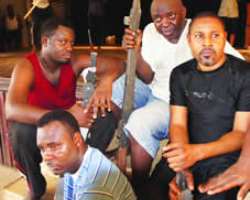
•A scene from Langbodo
Coming as an instructive drama for Nigerians and their leaders on pressing national issues, Wale Ogunyemi's classic, Langbodo, is currently being directed by Professor Ojo Rasaki Bakare in Akure, Ondo State capital.The play, whose command performance is slated for February 22 in the state capital, is to commemorate the third anniversary of Dr. Segun Mimiko as governor.
And for the first time ever, Bakare, who recently moved from the University of Abuja to the newly established Federal University, Oye-Ekiti, has commenced rehearsals with a 90-member cast, comprising leading stage and screen actors. The decision to engage artistes from both arms, according to Bakare, is to enable people watch many of the popular screen faces on stage as well as provide opportunities for them to learn the rudiments of the stage.
A timely political drama which chronicles the virtues of resilience, love, humility, courage, valour and peaceful resolution of conflicts, Langbodo was equally directed by Bakare as a theatrical menu for guests during the inauguration of President Goodluck Jonathan last year. But this time around, it is featuring popular artistes such as Kola Oyewo, Peter Fatomilola, Bimbo Oshin, Saheed Balogun, Yemi Remi, Jibola Dabo, Toyin Oshinaike, Joke Muyiwa and Bayo Bankole.
In less than two weeks of rigorous rehearsal, Bakare has almost completed work with the cast and crew of Langbodo, such that the play recently had its full run of over two hours. And as a mark of their determination to make the production a unique one, many of the characters have mastered their lines, while they have equally started working on movements and gestures.
The play opened on a musical note with the older Akaraogun (Peter Fatomilola), narrating the exploits of the seven brave warriors on a major expedition. The younger Akaraogun (Yemi Remi) was on hand to make the story a reality, just as the Oba (Kola Oyewo) summoned Akaraogun to his palace to embark on the heroic mission.
Expectedly, Akaraogun demanded the support of other hunters who were later on introduced to the people amidst exaltation. After offering sacrifices, seven brave hunters-Akaraogun, Kako, Olohun Iyo, Elegbede Ode, Efoye, Imodoye and Aramonda Okunrin (Saheed Balogun)- eventually embarked on the journey with a mission to bring an object (harbinger of peace and love) from Mountain Langbodo.
The hunters saw the mission as a heroic one, as well as a rare opportunity for them to serve the people and their community. Meanwhile, a tragic moment ensued when Kako's newly wedded wife, Pami Nku, tried to stop him from joining his colleagues, but a more determined and courageous Kako shunned his wife, offering to place national assignment above his personal comfort.
As part of the obstacles on their way, the First Medium (Toyin Oshinaike) predicted doom for the seven hunters, blaming them for accepting such a dangerous and risky venture. But the Second Medium (Joke Muyiwa) was available to counter the former, praying for the warriors and wishing them success and safe return.
The journey took the hunters to several locations where they equally encountered diverse creatures (birds, demons, lunatic of heaven, baboons etc) many of which they had to fight or kill before moving on. In most of their difficult situations, the hunters were either rescued by providence or the Mother earth, who was always ready to give them succour. At the aesthetic level, many of the encounters were dramatized or interpreted through well-choreographed dance steps.
Of particular importance are the various dance steps and costumes from the major ethnic groups in the country, which added colours to the entire total theatre package. In the same way, the hunters learnt so much about human foibles and excesses, as well as the need for them to embrace the virtues of patience, love, gratitude, benevolence, among many others.
On getting to their destination, the remaining three hunters were received in the palace by the king and the entire people of Langbodo. But rather than offering them the expected object of peace, the king admonished them, and reminded them about their experiences during the expedition. The latter, according to the king, should teach them how to live and how to excel in whatever situation they find themselves.
He nevertheless offered them a symbol of peace, which is metaphorically painted in Nigeria's colours of Green and White. However, the message of peace was threatened when the Devil hijacked the symbol from Akaraogun, leader of the hunters. Having lost four of their colleagues, and now the symbol, the hunters became frustrated, but with the support of the people, Akaraogun summoned courage and eventually snatched the symbol from the Devil.
Rather than ending the production on a pessimistic note as envisioned by the playwright, Bakare decided to give the audience a message of hope and reconciliation in his own version of Langbodo. This expectedly becomes instructive as Nigerians and indeed people of Ondo State continue to yearn for peace.
While explaining his mission with the play, the director recalled how relevant Langbodo is even 35 years after it was chosen as Nigeria's drama entry for the Second World Black Festival of Arts and Culture (FESTAC), which held in Lagos.
A multi-talented theatre practitioner, playwright, director and Dance scholar, Bakare has over the years proved to be a leader in the arts and culture community. He has written many plays in the process and directed many productions in almost all states of the federation. Having practised extensively and taught in a number of universities, the theatre impressario was appointed by the Federal Government to rescue the yearly Abuja Carnival in 2009. And within a short period of three months, he turned round the carnival and made it a success for local and international tourists. He was reappointed in 2010 and 2011 respectively to anchor the carnival as Artistic Director.