
CHIEF RASHEED GBADAMOSI: EVEN WITH MASTER IN ECONOMICS, MY DAD TAUGHT ME TO WRITE BUSINESS LETTER
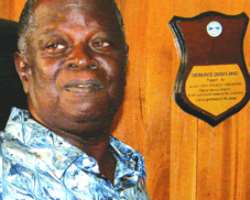
Rasheed Gbadamosi
By all standards, he is an achiever. Indeed, he couldn't have been anything less judging by his background and track records. Chief Rasheed Gbadamosi, economist, industrialist and former minister is an accomplished man. A scion of a successful industrialist, Gadamosi had wanted to be a doctor, but his persuasive father chose economic disciple for him for the purpose of continuity of the old man's company. 'Professionally,' the man begins his story, 'I'm an economist, but I have a lot of diverse interests.'
'I wanted to be a doctor… but one or two months before I left school, my father called me and said: 'My son, very soon you would be through with your secondary school education; what would you like to do?' I said I would pursue medical studies to become a doctor; but unfortunately my Biology was weak.
The old man turned to me and said 'the children of industrialist like me study no other course than economics.' I asked him what economics was all about? And he said: 'When you get there (university), you would understand. And right away, I'm going to send you to England for it.' I became excited about traveling abroad and I said 'dad, if that is the deal, to hell with medicine.' That's how I dropped the ambition of becoming a doctor.'
On graduation, he made a rapid trajectory, becoming, first, becoming a Lagos State commissioner and since then he has served in various regimes as minister and until recently, chairman, Petroleum Product Pricing & Regulatory Agency (PPPRA). A patron of the arts, in this interview, Chief Gbadamosi, who is also the chairman, Ragolis Water Ltd, AIICO Pension Managers, Lucky Fibres Nig. Plc and several other companies, tells the story of his life. In the same breadth, he instructs on what makes a man truly successful. Excerpts:
Let's start this discussion from your background, if you don't mind.
I was raised in Isale-Eko, which happened to be my mother's Fermat-era; she had root there. My father crossed the lagoon from Ikorodu to dwell in Isale-Eko where he met my mother and they got married. I am from a fairly famous home, so a lot is known about my background. However, for the sake of discussion, I like to say that I have been as prominent as you would be from age 24 or 25 when I started my career here in Nigeria. I was appearing in the media - I was on the television; I was writing for newspapers, doing budget reviews; I was chairing schools' debate and so on. I was writing a lot of fictions, many of which were produced. People in the media, especially the elderly editors like Sam Amuka, they know me. It was at 29 that I hit the limelight, when I became a commissioner in Lagos State. Professionally, I'm an economist, but I have a lot of diverse interest.
Growing up, did anything suggest you would turn out as successful as you are today?
Nothing, except that my mum used to tell me that my grandma used to looked into my eyes and prophesy greatness into my life. She would say I named you Oladosu (meaning wealth turns to moon and therefore I would blossom in life). That was it, even though I didn't attach much credence to it. Well, I also know that I was privileged to go through good schools.
What fond memories do you have of your youth?
A lot. As a Lagosian, life in Isale-Eko in those days was fun; great fun. I grew up among my peers; we were into this 'egungu' (masquerade) cult, playing with it from time to time. We were fond of it. Even now, I am back to it, because I have just been appointed the chairman of one of the Eyo groups in Lagos.
Can you recall some of the pranks, those wrong but pleasurable mannerisms you engaged in as a young lad?
Yes. Let me share one with you. Baba Ojukwu (Emeka Odumegwu Ojukwu's father) had a house within my vicinity. And the old man had an Almond tree within his compound. We would sneak into the compound to steal the fruits; we would use long stick to pluck the fruits and Baba would shout from his balcony: 'If I catch you boys!' We would scamper away, only to return when the man had gone inside.
So, you knew Emeka, the son?
I knew him very well; he was older than my group. He can be described as an Isale-Eko boy. In fact, he schooled there.
Sir, did you nurse any career aspiration as an ambitious young boy?
I did. I wanted to be a doctor.
How then did you veer into economics?
It happened this way. One or two months before I left school, my father called me and said: My son, very soon you would be through with your secondary school education; what would you like to do? I said I would pursue medical studies to become a doctor, but unfortunately my Biology was weak.
The old man turned to me and said the children of industrialist like me study no other course than economics. I asked him what economics was all about? And he said when 'you get there (university) you would understand. And right away I'm going to send you to England for it.' I became excited about traveling abroad and I said: 'Dad, if that is the deal (to go abroad), to hell with medicine. That's how I dropped the ambition of becoming a doctor.
You must have been born with the proverbial silver spoon then?
Maybe I am, but it wasn't inculcated in me. My father was the treasurer of the Action Group. He was a prominent politician. People like H. O. Davis, Akintola and several others were always in our house - even Chief Obafemi Awolowo. Each time he's coming to have lunch in our house it's always a fun-fare and special attention is usually paid; you would hear: 'There shouldn't be pepper in his soup ooo!'
Since your father was deep into politics, why are you not a politician yourself?
I tried and it was the same father of mine who dissuaded me. He told me, I know your temperament; you can succeed there (in politics) so don't bother to go into it. You can't stand the intrigues. I was angling for governorship ticket of Lagos state. That was the time Agbalajobi and Dapo Sarunmi were fighting each other; we were all there in a Movement called 'The Hope.' So, it was muted that I could step in to replace both of them who were forever quarreling.
A lot of people - volunteers - went ahead and printed posters. Overnight, my father ran from Ikorodu to my office here (Ikoyi) and asked: 'What am I hearing about you?' I said yes 'I want to vie for governorship seat of Lagos' and he said no way. He forced me right there and then to do a disclaimer that was published in national dailies. So that is the story of my attempt at politics.
You once said that you love play writing so much. If the hand of clock of life were to be wound back, would you love to take it as a profession?
Oh, I don't know whether to answer yes; but I can tell you that I adore it as an intellectual discipline, which I would like as a pastime occupation. Need I tell you that I have written no fewer than six plays? All published and can be accessed on the library shelves of schools and bookshops.
Experientially, how were you able to identify your talent?
I'm a sound economist and I have just told you that it was my father who, for the reasons best known to him, exposed me to economics. So, to answer your question, I should say that, that encounter with my father who insisted it must be economics, helped me to identify my talent. Again, surrendering to his wish on my return to Nigeria after my studies abroad; he said I must work under him in his company with a view to taking over after him. So, I went through his tutelage and can I tell you?
Strategies for success in business or corporate world are not taught or learnt in Business Schools. Forget the things written in textbooks. Business is experiential. I joined my father with a master's degree in economics but he was the one that taught me how to write effective business letters suitable to each need. He had up to secondary school education but the experience garnered from politics and German firm where he had worked before setting up his own company, was quite useful. And all those rubbed off on me. At 60, he handed over to me and I was determined to work hard and surpass him. The rest is now history.
Would you like to share with us the things that make you succeed where others failed?
You know there are virtues like tenacity of purpose, resilience and I-can-do spirit. These can never permit a man to give up in the face of challenges or what some people call adversities. And where you don't give up, that means you must succeed. Look into the lives of great men like Nelson Mandela, Barack Obama, and you would find all these.
You mentioned adversity as a human reality a while ago. How best then do you think one can handle such condition if it comes?
I have to sound philosophical here. First, you must accept it as the other side of life; as the opposite of success or progress. It's man's responsibility to expect that adversity can come in any form. To this extent, he has to handle it just the same way he must handle success. Adversity is the flipside of success.
When would you describe as the happiest moment in your life, yet?
I should say the very day I got married; because hitherto, I was a happy-go-lucky, doing Omo Eko (Lagos boy) and chasing girls. And my father used to tease me: 'Hmm! You won't go and marry!' One day he was going to visit the Awos and he took me along. We got there and the first question that came from Mama (Awo's wife) was: 'How's your wife? You didn't bring her?' It was like, how dare you visit me without your wife? And my father teased: 'He wouldn't think of that; he's still playing about.' And Mama added: 'Go get a wife!' (Burst into laughter).
Who would you not want around you?
Oh! A man full of deceit; I can't stand him because for me, white is white and black is black. I like a truthful person because I like to deal with a person I have reasonable sense of predictability.
Can you recall the most pleasurable journey you have ever made in life?
Several of them - to places like Greece and so on, but there is a particular one I like to share with you. Just before I graduated from the university of Manchester, there was this student exchange programme that took me to Norway. There, I saw the beauty of nature - high, massive mountains and large body of water. It made profound impact on me. I can't forget the memory.
Does that account for why you live close to the ocean here?
Quite correct! In fact, I wish I could live here forever, but unfortunately, there are some Philistines (neighbours) who are going to block my view with their building about to be erected (Boisterous laughter). I love ocean view.
You were in government. Looking back, how would you assess the period you served?
My dear, not me but others should do the assessment. The first one was at 29 (years) when I was appointed a commissioner of Lagos State under Major General Mobolaji Johnson during General Gowon's regime, which was terminated by coup in 1975. There was hysteria; people jubilating that late General Murtala Mohammed has sacked a corrupt government; there were allegations against many government officials, but I can tell you that my own governor, Mobolaji Johnson, was not involved. He was a decent man.
The second time, I was invited by General Abdulsalami Abubakar to serve in his transition government as minister of national planning and I was there for close to one year before he relinquished power to a democratically elected government. How would I assess my performance? I can only say that I tried to bring into service the best of my economics and general knowledge. And as I said earlier, I leave my performance for others to judge; I shouldn't be my own judge or assessor.
Are there any lessons you took away that might be of help to those still in leadership position?
Anything that you cannot do in the open, don't do it in the dark. In other words, maintain transparency at all times. Simple!
Was there anything you wanted to achieve for the country but couldn't find enough time to do it?
Yes, it was when I was the chairman of Petroleum Products Pricing& Regulatory Agency (PPPRA) it was an appointive office by Chief Olusegun Obasanjo as president. At the time, the nation was inordinately consuming petroleum product. And the underlining philosophy in mind was how would you want to consume a final product that we were lucky to have through the blessing of God in a way that we were not using much but reserve for development for the sake of posterity. We don't have the right to consume everything in our life time because petroleum is finite; you dig a hole it springs up but someday it's going to dry up. The issue, therefore, is what did you do with the flow of resources at the time it lasted?
Having had the opportunity of representing Nigeria at the OPEC as well as having served as minister of national planning, I was advised to entrench a sensible price regime for us not be wasteful. And economic background has thought me that we should always save for tomorrow so you don't have to consume all you have today. Someday the resources might dry and you won't have any problem because you have made provision for the rainy day. Unfortunately, Nigeria's attitude was otherwise. We tried to change the trend through various price regimes until 'superior' wisdom prevailed. As if to make matter worse, it was also said that the nation has to take money largely from the petroleum sector to subsidize consumption and that is still going on.
Are you saying subsidising petroleum product is wrong?
That's what I mean. Using current flow of income to subsidise consumption is not sustainable. It is against all proven economic theories. In fact, I'm yet to know any economic proposition that says you can use the streams of income of today to subsidise what you shouldn't do (current consumption). What economics teaches is, let today pay for itself and do not overburden the coming generation. Unfortunately, we labour hard in Nigeria to create problems for our future generation. It's sad because the consequences are inescapably dire. The funds that should be conserved to develop electricity, fix your roads, railways and other key economic infrastructure are used up in subsidy; that is what I find wrong in the whole thing.
The point I'm trying to make is, electricity sufficiency is far superior to the current consumption of petroleum products being enjoyed. Inordinate consumption has repercussions, which in our own case, include our inability to generate enough funds to invest in agriculture, allied industries, solid minerals, set up clusters of industry to take unemployed youths off the streets and so on. Can I tell you? You have over 2000 various products to be made from one barrel of crude oil, but hardly do we make up to ten. At close to 68, I don't think I have much time to live. I have preached all I could preach, unfortunately, people prefer the broad, easy way to the narrow and more profitable route. The repercussion is ahead.
As a man close to the twilight of his life, as you mentioned a few minutes ago, what's your message to people in leadership?
Good question! My message is as follows: Quality leadership; good leadership to your society. Singapore, Malaysia, Indonesia and India were basket-case economies. First, India had a drought in the '60s whereby the situation was like India eating out of rubbish can. And Indira Gandhi said he was not going to accept it, he took the country and shook it into shape. Chairman Mao, in the same manner, took economic reform steps in China when he said: 'We have been the butt of everybody's jokes' and he had to reverse the ugly trend to the benefit of China as a nation. October 1, 1949 they declared the Republic of China. October 1, 1960 Nigeria became independent. Is there no significance there? But look at where China is today and where Nigeria is. It's something for us as a people, especially our leaders, to ponder about.
Speaking from the point knowledge, what would you advise President Goodluck Jonathan to do?
He has laid down his agenda for a term of four years. Good luck to him. Within the term of four years he must take steps to put the economy on the economic growth. To achieve this, he needs a damn good team. Malaysia was at a point in bad economic situation; the then Prime Minister decided that his must be agriculture-led economy to transform his country. What did he do? He came to Nigeria to borrow palm oil seeds, cocoa and rubber seedlings. Thirty years later, his country left Nigeria way, way behind. It is sad. But be that as it may, hope is not lost. Nigeria can still regain it lost glory in agriculture, if we can exercise the needed political will power to entrench and implement necessary economic policies that can turn things around. We must move forward!
Would you like to talk about your most treasured possession?
My grandchildren! They are the ones I treasure most. I have my children in whom I have invested so much and they are well educated and doing well in the various positions they occupy, but at about 68 when I look at these grandchildren, I become emotional, wondering how this life can be elongated.
Asked to change three things about yourself, what would they be?
To be able to shout less (Bursts into laughter).
But you haven't shouted since we have been here, or…
Oh! I'm being civil to you; don't dare me.
So, why do you shout?
I'm quite impatient because I don't suffer fools gladly. When I feel there are obvious answers or ways to arrive at solution and people don't seem to understand it, I get temperamental. I also frown at sense of disrespect to force of history. History is there as a people. You came from somewhere; where we are heading to is important but we must always try to find out and understand where are coming from and then be able to relate to our origin. Unfortunately, we reject our history and try to copy other people's way of life, particularly Western culture and we are neither here nor there; neither Africans nor Western people. It puts me off.
I try to read about the history of various ethnic groups in Nigeria to learn what makes them thick; what accounts for their mode of behaviour, arts and so on. Even the mode of worship of various people; what you call witchcraft is rubbish as far as I'm concerned. You condemn it; I don't and I don't buy the proposition that things are necessarily fetish. My proposition is that any science or art that has motivated man to create something and be in tune with nature is commendable. So, I don't understand why you criticize witchcraft. Such varied knowledge enriches my life. I love nature and that's why I collect art works, sculptures etc.
Do you believe in life after life?
I haven't been there so why do I have to believe in something I know nothing about? If I want to be diagnostic, once you shut your eyes and you are thrown into the earth (buried), that is the end. You might have left some legacy; so people might remember you, that's all.
In life, who would you say you admired most?
Of late I should say Nelson Mandela and Barack Obama.
What do you see in these people you have just mentioned?
Resilience! Ability to stand against adversities and do things, which are of benefit to them and to their society. When I was in America in the 60's, carrying placard (against racial discrimination) and singing: 'We shall overcome someday…..' I never believed that in my lifetime, a Blackman would emerge as president in America. Also, Mandela, the indestructible human spirit, he was caged for 27 years for standing against apartheid. He came out and was still able to provide leadership not only to his people but also to the African continent, leaving example for the whole world to emulate.
How would you like to be remembered?
A man called Rasheed Gbadamosi came, he waltzed through life and left some imprints on the sands of his time. That's all!