
PROF. UMARU SHEHU: MY GREATEST FEAR IS…
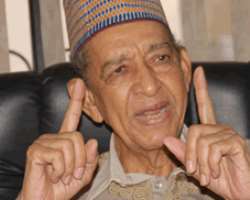
Umaru Shehu
This is the concluding part of this interview. Last week, Umaru Shehu, Professor Emeritus and the Chairman, Governing Board, National Agency for the Control of AIDS (NACA) took us through his early life - how his perception of hardship as a child was as normal as life itself. Instance, 'You didn't think about life as being hard; it was just normal life.
For example, when I went to elementary school, we didn't have pencils or paper. We didn't have chairs or tables or benches to sit on. We started writing on sand. We would sit on the ground and write our letters. That was how we started our education. Nobody thought of giving us chairs or tables because they were not there.'
A physician of the old order, he also discussed his early influences and his fascination for 'men in white coat' as the beginning of his love for medicine. At a time, he left medical practice for the academic, rising from Reader to Deputy Dean, to Pro Vice Chancellor (Adademic, ABU), to Vice Chancellor (Nsukka) to Pro Chancellor (Bayaro and Unilag at different times). He traced the history of how this transition was worked. To all this, the man Shehu of the Kanuri stock, attributed to 'fate.' At 81, he remains one of the few older Nigerians with manifest sense of propriety and prudence.
Here, he talks about his world as an adult and an old man.
Excerpts:
You were the VC of the University of Nigeria, Nsukka between 1978 and 1980. Am I right?
Yes, you are.
Only two years?
Two years, yes.
Tell me, what was your experience there?
It was very different because that is a whole story; a big story on its own. I told you, I was in ABU and I went on Sabbatical to North Carolina for one year. And while I was there, the WHO deputy director, professor Lambo called me and said, we have a problem in Nigeria and said, please stop over in Geneva on your way back home. So I stopped over and he told me that Nigerian Government insisted that there must be a Nigerian to head WHO in Nigeria. And I said, 'so, where do I come in here?' He said the government said they want you to do that. So I went.
When I came back, I went straight to Lagos to see his Excellency General Obasanjo, the then head of state. So, anyway, I was appointed and I was in the Ministry of Health. One day, I was having a meeting with the programme officers in the ministry. Then Grey Longe, Secretary to Government at the time, they just finished the Supreme Military Council meeting, said to me (I just divulged a secret to you now) 'congratulations.' I had just been doing the WHO job six months so I said: 'I have been here six months and today you still congratulating me.' He said, 'no, no, no, you have a new job.'' I said WHAT? So he said, 'okay you will get the news anyway.' Eventually his Excellency said I should go to Nsukka as Vice Chancellor. Well, I had left the university (Ahmadu Bello University as Pro Vice Chancellor (Academic)) to work for WHO, if I wanted to be VC, I would have stayed in the university. He gave me such good reasons I couldn't say no.
So that was how I got to Nsukka.
Now, when I went to Nsukka of course I still had this job with WHO. I remember that General Obasanjo had asked me, he said, what are you going to do when you leave? I said maybe I will stay one or two years in Nsukka and retire and go back and start a private practice. So he said, what about your job with WHO? I said but you are sending me to Nsukka. So immediately, he called the commissioner of health and said, 'look, nobody must be appointed in this position until Umaru Shehu comes back to take this position. Can you imagine that? So I went to Nsukka and I said that I would do anything I could.
Although there were a lot of problems, it is rewarding. Even yesterday when we were attending a meeting, many of the people said, 'oh you were my teacher, you signed my certificate.' They never forget, that is one good thing about that. But in ABU where I spent much longer time, I hardly do you find someone say, in London, say, 'I was in ABU when you were this or that.' But Nsukka, incredible, they never forget. Well, it may be that, that is how they are or what Umoru Shehu did, I don't know. However, it was not easy, in the sense that there were certain cultures that…. For instance, the culture of going to authority telling about somebody else. Someone would say, watch out for this man.' Everybody wants to advise you and in the process, they are trying to pull somebody down. It was unfortunate. That was one of the things that I felt I didn't like, but within a short time, I got over that.
But otherwise, I had the greatest of co-operation from everybody. Everybody accepted me, helped me and so on. It was a great experience. And what was more fascinating was that even up till today, they remember this more than I do. And we had two campuses of course, Enugu and Nsukka. And some of the people who worked for me where all over. One of them, whenever I meet him, will say: 'here is my boss' and I said no. One of the things I wrote in my handover note to my successor is: 'Be a leader and not a boss.'' And he said, 'Why did you write that, sir?'' I said, 'well you will find out.' What I am really saying is that, because of the co-operation and understanding of the staff there, I really enjoined my stay and it was really memorable.
Integrity, what does it mean to you?
Well integrity means to me, doing the right thing without any bias, whether it is your kith and kin or your friends are involved or not. Secondly you must be able to explain whatever you do to your conscience. Even if you do something wrong and because nobody is perfect, you must convince yourself that the error was committed in good conscience. Only God is perfect. I am not saying that people don't make mistake, but if you make a mistake you say yes, that is a mistake and you try to change from it. But if you ignore it, you know it to be wrong, then you lack integrity.
Then another thing, integrity is not a one-time quality. It is a continuous quality. You must carry integrity throughout your life in whatever you do. And that is a mistake we make. So, integrity to me, is honesty, morality and ethics. All these contribute to integrity.
I'm just thinking, with all of your learning and all you have acquired, academically, that is, why are you not in politics? I ask this question mindful that politics seems to be the only viable business now in town and everybody that can throw influence around find recourse in politics.
I don't know. I never really thought about it. I mean, the closest I came to politics was being a prefect in my school days. I was given leadership, I don't know if it is politics or social. True, I really have not given a thought to politics. Even in those days, when I grew in civil service, there was no question of any civil servant saying that he was going into politics to vie for position. Now civil servants are leaving to go. Really, it never even occurred to me.
Maybe because I really never seen any attraction in politics. Secondly, I have got on very well with politicians, whether good or bad and they gave me normal respect and I tell people that when they are leaders, you and I chose them and I will not undermine their authority. If I have the opportunity, I will tell them what they are doing wrong and what they have not gotten right, even my governor, I told him, 'your Excellency, right or wrong, you are responsible for what you do. I mean you can't say Umoru Shehu advised me.
So I follow you, you may throw away what Umoru Shehu told you, do something else, but I won't say I will undermine your authority because you didn't take what Umoru Shehu told you.' So I have never been attracted to politics. When it comes to voting, I will vote and I won't even tell my wife who I voted for. So really, I haven't seen any attraction in it. Most people look at this as power and money because they wield power, some of them rather crudely, unfortunately. And then money of course, is always going the politician's way. And then power, if you put me in charge of NACA (National Agency for the Control of AIDS), I will exercise the power given to me by the Act and nothing more. And if you give me pension that is so small, I have to live with it.
You just mentioned politics and money. Every Nigerian knows this is a big problem, even those who directly profiteer in it also appreciate this. Now, knowing that no nation can sustain for long with this, what do you think we should do?
You mean, sanitising politics? Well, you have to educate the public.
And the politicians.
What I say is when I, say in Maiduguri, a politician going in a four by four jeep, in a convoy with dark glasses and then they come to the market and throw about N50 or N500 notes and you see poor women selling tomatoes and others leave their wares and go right in the dust. Let's be honest, that money being wasted is their own money, it is public money. But they think the person is giving them money.
Now, if you educate people and they understand the essence of government that you elected them and you gave them all these powers that they have. The only thing they can say is that from now, on it cannot be practiced in that manner. I mean, I don't want to say it, but let's take the Sanusi's thing with the Senate about the amount of money that goes to legislature. This sort of thing is incredible. And one senator, during the last election, I know him very well, he is a very fine person, said give us your account number, we will pay your salary. And when he saw the payment to his account he was shocked. But obviously, he didn't say no because you know the environment because he had spent a lot of money to go into politics. And some of these things I carry with me.
The last legislature, a commissioner in Niger State said the most lucrative democracy in the world is in Nigeria. Now, as long as it is seen as this, spend and make more …or people go on oversight function or you hear from tertiary institutions, their heads, saying 'I had to give this money to the chairman, I had to give this money to the members.' Now if the head of the tertiary institution says, no, not a kobo, what will happen? He won't survive long. But when this happens and you people come in and say this person refused to give a kobo to people who came for this sort of thing. Now, that will set sanity in motion. But again, one is very reluctant to go to this extreme because it will just backfire in most cases. So what is the answer? First, public education. People must be educated to understand their role in government. This is the trump card they have. And what they can demand from this, not as individual but as communities.
A year or two ago I was monitoring polio eradication and I noticed that those who were taking records, I mean, we take them and we train them and show them how to fill the records and they didn't know how to fill the forms. In one particularly instance, they said particular information was not on the form, I said turn the back and they turn the back and it was there. So what happened? We took people and trained them. It shows the level of bastadisation of this thing. And then the local government withdrew them and put their relatives.
So to that extent, polio eradication and we were looking for information as to what level of immunisation and how many people were complying and the people who were trying to bring the information were not being kept on the job. So I don't really know. It is certainly too late for me to go into politics…
But sir, I know that in your time, when you were younger, in the 60s and 70s, the society was not as polluted as it is now. Standards and morality were high. At what point did we get it wrong? What happened?
Well, I don't know because one doesn't know some of the history. You know when the coup took place and somebody like Sarduana was killed and they said one of the reasons was corruption. I know because at that time I was his physician. Now, traditional gifts are received by people in positions. You can't stop that. Somebody said that if someone gave N100 to Sarduana, that is traditional gift and not a kobo will spend the night in his house. He also will give it to someone else.
Now, this may be good or bad but this is tradition. It takes a long time to wipe out that kind of tradition. Now, if you get a public service job and you manipulate to see how much you make out of it because I can't even think about, anybody, any perm sec or any public servant making inroad into contract awards for example in those days. I don't know, but obviously, I am sorry to say that the militarisation of the government has had a lot to do with it because even if they didn't do it, many people will hide behind them to do it.
But then one can't say I woke up one day to find this thing going on. I don't think that is true. It has been happening gradually and people didn't take it seriously or try to do something about it until it became the norm, virtually. But Nigeria is such a big and complex country. When did it start? I don't know. Did it start in the local government level? The state level? It is very difficult to…
So what could have brought about the decay?
I think it is what I said earlier about our culture. And then if you send gift, these are part of us and you can't stop it. But the other side of it is that it is something that is proportionally out of place and is not in tune with cultural sync by using the dispensation to magnify the situation and there is nobody to say no or we don't do that in our society.
I mean, having worked in the East, I know that there are some things that the Igbos must not do in the society. And if you do it, you will get sanction. But in this other thing, there is nothing like that. And so, the question is who is the regulator? I think this went on and became a norm. So really this is so complex. I mean, I can look at it from my own thing.
You are the Chairman of National Agency for the Control of AIDS.
Yes.
So, how far have you gone in the control of AIDS?
Well, it is a very difficult question to ask because such claim will have to be based on facts and facts are very difficult to come by in Nigeria. People disregard information; they don't care about information. And information is the basis of accountability, progress, because if you don't know where you are, you don't know where you are going. In fact, Prof. Ade Ajayi who in his lecture in America once said it is important to know what has happened in the past because the past co-exists with the present because it is a carry over of the present.
If you don't understand the past then there is no way you can understand the future. It is even more important in order to plan for the future; you must understand the past and the present because they co-exist - they flow from one to the other. So really the question is, at what point did these things happen… without information, for instance we say the prevalence date is four percent here, seven percent there. Really, I am sorry being the head of NACA, I shouldn't be saying that, but it is really.
What will make you angry?
Like I told you, I was invited to chair a ceremony in Lagos where a product was being launched and somebody that was involved in that thing who was a minister - he knew me of course - he turned to me and said, 'why don't you get angry?' So I said, Honourable Minister, I did all my fighting in elementary school in 1930s where I fought all the big persons. I chose the biggest ones and they beat me. Once I got hold of their dress, they couldn't get away from me.
So I said, I finished all that in those days. So, to fight, to quarrel to abuse, just doesn't occur to me. So that is your answer. I really don't think anything will make me angry to the extent that I will be exchanging abuses or fisticuffs. Well, it is too late anyway, even a young boy now will knock me down, but all my life, I don't know if any of my schoolmates will say Umoru Shehu was angry in 1940-something or '60-something. I don't know anybody in this world since I knew myself that I said I don't like this man. I just go away if I don't want to work with him. If I don't want to play with him, I walk away.
And what is your greatest fear in life?
I think my greatest fear is when I am alive, my children or grand children don't do well in life. For me, I thank almighty Allah for giving me all these. They say death is a necessary end. I don't think anybody should fear death because there is nothing you can do about it. But at this age, of course, when you are much younger, you don't think about death but when you get suddenly old, it is inevitable, it is coming. So there is no need to fear since there is no way that you can prevent it.
So how well are your children doing now?
All my children are grown up of course. They are all doing well.
Are they all in Nigeria?
They are all in Nigeria.
Any of them taking after you as a doctor?
No. None of them wants to be a doctor.
Why is that?
I don't know even when I was in ABU and head of the teaching hospital there, they chose their own life - even at that time and I went along with it.
And you have no problem with that?
No. Not really. Well, here and there, sometimes we have arguments over that but then the past is gone. A few months ago, I was sitting here when someone brought me a parcel and when I opened it, there were two books sent me, one is Don't be Angry and the other is about religion, Islamic religion. And when you go through it is exactly the same thing about the past, the present and the future.
Are you a rich man in terms of material wealth?
Well, I have houses.
How many?
I will give example on how I came about them. The first one was during the old Northern Nigerian civil service. A civil servant's ambition was that when he retired, he would live in Kaduna - such a lovely city, not like now when they are killing each other. And so the Northern Nigeria Government encouraged the Civil Service Housing Loan Scheme, three percent interest. I will show how this relates to the question you made. And so as one in a senior position I got a plot. I applied for a plot but this will interest you because then the ministry of lands and survey said to me, but you have a plot in Kano. I had even forgotten because when I was to work in Kano I applied for a plot in GRA but I had no money to build it. But in Kaduna, they knew about it and they wouldn't allow me to have two plots so I gave it out.
So you gave up the Kano plot.
Yes. Otherwise I wouldn't get anything. So when I got the plot and made the plan, it was going to cost 5,200 pounds to build and my salary then was 2,500 pounds. So there was a balance of about 2,700 pounds, something liked that. So I had a query that where are you going to get the balance to build the house.
So I had to bring my bank account to show then that I had saved and I had been a civil servant for ten years and I had saved so much money. Yes, I also have a house in Maiduguri where I live and that is UBA. And I was working in WHO earning a lot of dollars and so on. (PA comes in and announced that he was already late for the airport). Ahh, sorry, Bruce, but I have to leave now.
I understand, sir. Thank you for your time.
Yes, we'll meet again.