
AKWA IBOM: ATTAH, AKPABIO IN CLASH OF TITANS
Akwa Ibom State is made of a homogenous group of people believed to have originated from a single ancestral stock. The languages spoken in the state are closely related. The Annang and Ibibio languages are identical, with a few dialectical differences. The Eket and Ibeno languages are more closely related to each other than to the other two, and are only partially understandable by speakers of the other two languages.
The Ibibio are the largest group, whilst the Annang, which form the second largest group, speak a language very similar to the Ibibio language. Ibeno and Eket speak a similar language and are located beside the ocean.
According to Nigeria's 2006 census, the state is home to some four million people. It has population density of 466 people per square kilometre, three percent of Nigeria's population in the 36 states. The dynamics of the population of the state are controlled by the effect of fertility, mortality, immigration and emigration. There are vast areas of permanent swamps along the Enyong Creek and the coastal areas of Efet, Mbo and Oron, which are either sparsely populated or totally uninhabited. There are swampy areas, unsuitable for settlement in the lower Cross River State valley in Ibibio, Itu, and Uruan Local Government Areas. (LGAs)
On September 23, 1987, the south western population of Cross River State got created as a new state called Akwa Ibom. The state was carved out from the Uyo, Ikot Ekpene, Eket, and Abak divisions of the Old Calabar Province.
Akwa Ibom has abundant natural resources, infrastructure and a good investment climate.
Politics
Until the 2006 governorship primary of the Peoples Democratic Party (PDP) that propped up governor, Godswill Akpabio, the state had enjoyed a relatively stable politics with little or powerplay and intrigues. Criticisms of the government and power transition since 1987 had been constructive and well- meaning. Since 1999, it has been ruled by the PDP, with majority of its prominent political players in the party. The situation made people to dub it a one-party state. Today, the politics of the state has taken a trenchant dimension. Bloodletting, violence, armed robbery, kidnap and other forms of hostage taking dictate the currents of its politics. This new wave of intrusion into its politics has heightened tension and elevated the element of uncertainty to unprecedented heights.
An ex-minister of women affairs, Obong Rita Akpan observed that: 'Some of our children have gone astray.' According to her 'our state that used to be peaceful is now dreaded by visitors. Blackmailers, hired assassins, cultists and kidnappers have taken over the state. We have to pray and call on God because kidnappers entered the church and killed innocent people.' She stressed the need for the women of the state to come together and cry to God so that he would deliver their children from all the social vices plaguing the state, save it from chaos, and the governor from distractions.
The worsening violent climate in the state increased in 2009 after a former commissioner in the state was arrested and arraigned for kidnap and murder.
In the ensuing orgy, no place was so sacred to be spared, including churches, palaces and private homes
A rattled governor Godswill Akpabio has stepped up actions against the ills. He tremendously equipped the security agencies in the state, engaged the traditional, and religious leaders in a frantic search for an end to the malaise.
On February 26, 2009 he assembled all the royals at the Ibom Hall, to meditate and curse all kidnappers and sponsors in the state and to solicit for their assistance to rid the state of the evil by identifying and reporting the criminals in their domains.
As a follow up, on February 13, 2010 he declared a three-day fasting, following the killing of two women at Owo Iboe church Iwok l, Nsit Atai. They were murdered by the kidnappers while trying to abduct the retired General Edet Akpan, former Director of the National Youth Service Corps (NYSC).
Although, kidnapping was first noticed in the state in 2005, when some Mobil Oil workers were abducted in Esa Akpan Estate in Eket, the upsurge between 2007 and today is frightening. Governor Akpabio blames it on some politicians without conscience.
Under the veil of the violence are a surfeit of political brickbats, innuendoes, and marksmanship that have elicited tension and entrenched confusion, intrigues, and an uncanny manipulation of the political process to create divisions.
Until the implosion in the state chapter of the PDP late last year that forced many of the leading politicians to leave for other parties, the state was virtually with no opposition parties. The existing parties in the state then were fledgling and utterly supportive of the PDP led government
Unlike most states of the federation, the state boasts of a vibrant youth group under the aegis of Akwa Ibom Youth Congress (AYC). The youths since 1999 have been active and integrated into governance. The youths that form the largest corps of voting population will play a vital role in the emergence of a winner in the April governorship polls in the state. A good number of them head vital organs of government and have been clamouring for the sustenance of the generational shift of power that brought Akpabio in as governor in 2007.
A former Military Administrator of Ogun and Rivers State, Group Captain Sam Ewang (rtd) recently, identified insecurity as a major issue confronting Akwa Ibom State as the April 2011 polls inch closer.
The All Nigeria People Party (ANNP) governorship candidate claimed to have received threat from kidnappers. 'There is security problem in Akwa-Ibom and I want to directly accuse the governor because, he is the chief security officer.'
Ewang is not alone on this. The governorship candidate of the Action Congress of Nigeria (ACN), and former Minister of State for Federal Capital Territory (FCT), Senator John James Akpan Udoedehe, has also revealed that 'there are some boys in Akwa-Ibom who call themselves the twelve disciples. These are cultists. These boys have taken politics to the highest level of violence.' Beneath the veneer of politics is the nature, and style of politics in the state. The troubling relationship that has existed between Akpabio and his predecessor Arch. Victor Attah is also dictating the tone of what to expect in the April polls. Akpabio did not come into office on a platter of gold. At the Peoples Democratic Party, PDP, primaries in 2006, he sweated it out with 59 aspirants. The first attempt ended in a deadlock. His closest rival, Dr. Udoma Bob Ekarika, was Attah's preferred candidate and this spawned a long drawn battle, which is yet to simmer.
Akpabio has since situated the acrimonious 2006 primary as the main ingredient of the endless tension and subtle challenge to his regime, in spite of the many achievements he has notched up in the last three and half years. Reacting to criticisms of his administration by Attah, he said: 'These are people who are still fighting the concluded 2006 governorship primary. It is unfortunate that the former governor commissioned a lot of uncompleted projects. It is not my fault that in eight years he could not complete any project. He should allow us to do the jobs we were elected to do.'
There is a sweeping impression in the air that the political bitterness in the state is fuelled and sustained by hangers-on and political jobbers on both sides.
One of the aides to the former governor who preferred not to be named, while suing for peace on the part of the two leaders highlighted the bogey value of intruders and opportunists in the face-off.
'They should be wary of those who shout Hossanah today, because when the language will change, the same people will turn around to shout crucify him.'
The assistant secretary of the ruling PDP, where the battle, until recently has been fierce, Prince Idongesit Etim underscored the seething rage within when he said
'Attah's position on the affairs of the state is divisive. Though we respect Obong Attah, we should go for generational power shift. This government is quite different from the one he ran.' He advised that the ex-governor should not be involved in the pull him-down act, the state is noted for, but rather inject his wisdom and sagacity for the progress, peace and harmony in the state.
Battle within
Until a few weeks ago, the PDP in the state was red hot with rancour. Being a one- party state, the bad blood ricocheted and threatened to foreshadow the forthcoming elections.
Governor Akpabio strutted about receiving second term endorsements virtually unchallenged. The endorsement even came from 'opposing parties' which unarguably made the governor boast sometime ago that he is the leader of all political parties in the state. Apart from two former aides of Attah, Mr. Imoh Udo and Mr. Frank Okon who stayed put in the PDP and slugged it out with Akpabio at the primary in January, the others, found solace in other parties.
The duo engaged Akpabio and even secured a court reprieve for a re-run which was done. With the PDP governorship ticket now secure in Akpabio's kitty, the challenge in the April polls will come from the former National Chairman of the Progressive Peoples Alliance (PPA) Chief Larry Esin, who is flying the banner of the Congress for Progressive Change, (CPC), Ewang, who despite a celebrated threat by kidnappers to drop his ambition is waging his guber war from the ANPP, Udoedehe, in ACN, and Mr. Idorenyin Unoh, who is in the Labour Party (LP). This makes it a five-pronged race. Under this configuration subliminal issues like ethnicity are attempting to get back to the front burner again. Akpabio, from the minority Annang tribe, has held the things that hold the disparate ethnic groups in the state together by ensuring equitable balance in appointments and distribution of social amenities. He conceded high profile appointments to the majority Ibibio ethnic group, which has ruled the state since its creation in 1987. These include Deputy governor, speaker, chairman of the party, several commissioners etc.
Udoedehe an Ibibio, and Director-General of Akpabio's campaign organisation in 2007, again steps in 'when we gave power to the minority in the state, with love, we did it with the hope and belief that the young man is bringing in generational change. We did it in Akwa-Ibom before America did it.
We did it based on love and understanding that there will be peace. There are so many ethnic groupings in the state today, which should not be the case. The essence of the proliferation of these groups is to weaken some perceived political opponents. It's not that I don't love Annang. I stood with Etiebet for many years when people left him.' Among the elite in opposition there is a convenient resort to accusing the governor of intolerance, which inexorably has led to the immanent tension in the state today.
Concerned leaders of Ibibio people a nascent group of political elites moved into the fray to douse tension.
At a meeting it held in Abuja on February 4, 2010, the forum condemned in strong terms the level of insecurity that has left indigenes of the state in fear and in siege and sued for tolerance of divergent political opinions and leanings. The forum noted with strong disapproval what it termed 'selective kidnap, intimidation, harassment, and killing of prominent Ibibio leaders and politicians, and expressed the hope that these actions are not in furtherance of well planned ethnic cleansing originated at the crisis of the Ibibio union of old.
It called on Ibibio sons and daughters not to weaken in the face of this tyranny, but to brace up and be prepared to guard their rights and freedom jealously.
The forum reminded the people of the state 'if a finger is injured, the entire hand is affected.'
This call may have given vent to the emergence of mammoth socio-cultural and political organizations in the state.
These include the Akwa Ibom Democratic Voice (ADV), which is in the forefront of support for Akpabio's administration and a counterpoise to the opposition. It has crystallized into a mad scramble by opposition members for positions in the already existing clubs like Utuenikang Ibibio, G31 for one, ALGON, Akwa Ibom Peoples Forum (AKPF) Akwa Ibom Women in Politics (AKIWOP) and even the traditional institutions.
The monarchs have also banded to have a voice and influence in the spiraling conflict in the state. Today in the state, you have the traditional rulers council, council of village heads, etc. These groups are represented in the 329 wards of the state, working for the re-election of Akpabio. Captain Imobong Ekong (rtd), chairman Utuen-Ikang Ibibio and immediate past transition chairman of Nsit Ubium Local Government Area of the state described Akpabio's regime as 'legendary and God sent.' On a cautious note he observed that those with differing opinions are entitled to their positions.
Prince Bonny Nyong, a commissioner in the Board of Akwa Ibom State Law Reforms Commission as well as Mr. Ifiok Inyang, the state secretary of ANPP and a member of the board of Ethical and Attitudinal Re-orientation Commission, (EARCOM), also expressed satisfaction with the stifled opposition from other parties. But the state commissioner for information and social re-orientation Mr. Aniekan Umanah believes that no amount of opposition will dwarf the enviable record of achievements of the governor, which according to him is made more appealing by his continuing popularity. While the din of insecurity raves, the special adviser to the governor on political and legislative affairs, Barrister Jerry Akpan affirms that the state has overcome its security problems 'the security problem is everywhere. It is not peculiar to Akwa-Ibom.
But thank God we have arrested the situation, and I am very sure that before the elections it will be over. Our able governor is doing everything humanly possible to beef up the security situation in the state because he has taken an oath of office to protect the people and their property. The problem did give the governor sleepless nights. As a matter of fact, I see these criminal acts as activities being sponsored by the enemies of progress. I am not God. So, I will not be a party to those of them that allege that the criminal acts are sponsored. I will still say it is the handiwork of the enemies of progress. These people are not happy with the developmental progress of the governor. They are trying to cause mayhem. They are trying to cause distractions. They are trying to kill. They are trying to maim and kidnap, so that people will see this administration as bad one.'
Taming the anger
Since the tempestuous politics crept into the state, several stakeholders and interest groups have intervened to bring the situation under control before the elections. The efforts have so far been futile. As pacts of peace are notched, new flanks open up. In November 2007, all the past governors of the state met to resolve the differences between Akpabio and his predecessor, Attah. According to Chief Idongesit Nkanga. 'past governors had already intervened in the crisis between Attah and his successor. About the end of November, just after his birthday in 2007, we had a reason to see that things were going wrong between the two.
All the former governors except General Godwin Abbe, he could not make it because of ministerial appointment -everybody, from Ogbeha down to Ebiye, who was the last person, was here. We spent three sessions; the first session with Godswill Akpabio and the second session with Obong Attah himself, and in the third session, we got all former deputy governors to join us. It was only Etimpepo Uyo, who was outside the country, that couldn't make it. Every other person, Chris Ekpenyong, Michael Udofia, Ufot Ekaette, were there at the Governor's lodge.
'At the end of it, Don Etiebet, former governor of old Cross River State (spoke on our behalf). It was like giving them an injunction. We don't want to see anything in the papers either directly, from you, or from your supporters. That was what we did in 2007'.
The ex-governor continued, 'shortly after, the thing started again. Just three months ago, when we were at a function in Shelter Afrique, something had happened that day and we felt something was going wrong. When we finished, Godswill, Ebiye Adewusi, the speaker, senator and others and myself drove to Obong Attah's house at Shelter Afrique.
We sat down with him; we rehearsed all those issues again that he had problem with and said, please let this thing end. He went in and brought drinks and everybody was quite happy. We thought, everything was over, only for us to see write-ups in the papers again. We have intervened, and now I have spoken to some of them and they said what else could they do.'
Several eminent citizens and traditional rulers have also intervened to no avail. When Attah turned 70, a landmark age by every calculation, Akpabio shunned the well-attended event.
Attah has also at several public fora vowed to scuttle the re-election bid of Akpabio. Both men in readiness for the electoral war are out bidding themselves in the recruitment of supporters and associates. So much is the build-up, that no one for certain is underrating their capacity to out do one another.
Wits, propaganda
Determined to have an edge, the two combatants have taken the battle to the public domain, incisive speeches aimed at whipping up sentiments, have been the order of the day, with less than eight weeks to the governorship elections. Aides of both men are also having a field day, causing confusion. On this, Udoedehe blames sycophants. 'The people that see the governor everyday tell him stories about everybody. They have done a lot of damage. They try to destroy every other prominent person in Akwa-Ibom by manipulating things around him.
An associate of Attah, Etim Obong explains that 'for the sake of records, Attah is a leader. If he speaks, whether you like it or not, over 70 percent of the people will listen to him. He sets agenda. Even before he became governor, he was a consultant of repute; and he did the master plan of Uyo, and having been a governor in the state, he understands the terrain very well.
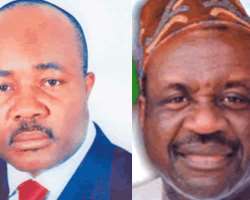
The stage is set for a titanic battle of godfather and godson, which promises all the excitement of power play and intrigues that come with it.