
NIGERIA: OF PEACEKEEPING OPERATIONS AND NO POLICY
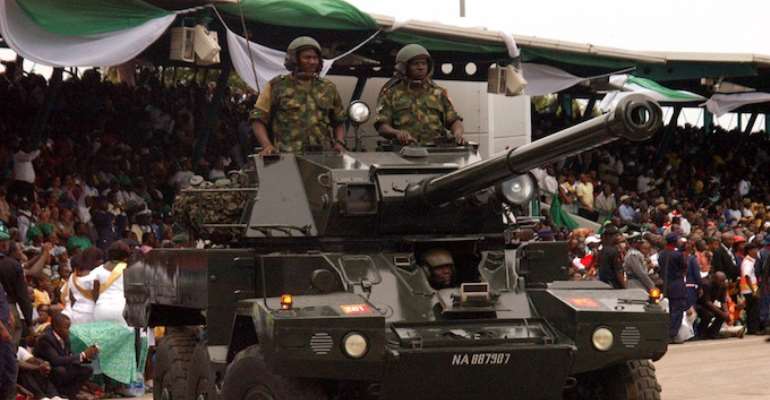
The nation’s Defence Minister will soon become a soldier. By the way, Adetokunbo Ademola is a lawyer, a SAN even, which means he is a senior. But check him out in army uniform, and one would think he is on his way to Afghanistan. Some regular officers may be passed off as civilians when the minister stands among them. That’s what you get when people with fresh ideas are placed in the right place. There is need to clap for Mr. President for sending Ademola to Defence.
That policies are there but not implemented and, in some cases, are not there at all is a known fact in this nation. Think of an annual budget that is implemented up to 40 percent, and the picture of a policy that gathers dust on an official’s shelve becomes clearer. And there are instances when needed policies are not just there. One of such is in the area of peacekeeping operations. But every administration here loves the idea of peacekeeping. Ask for concrete achievements in power, and they mention peace keeping. They are not lying. Nigeria is first in Africa, and the fourth in the world as a nation that send troops out to keep the peace. It sent its troops out barely a month after it achieved political independence even.
It is a tradition, sending troops out. It is also a thing of pride, helping nations out in times of trouble, especially in Africa. Nigeria is its brothers’ keeper, except that it does not take care of its own brothers (or is it sons?), at home. That has meaning. Nigeria sends its men out without a clearly defined policy framework on cost and benefits. No wonder soldiers died like chickens in Liberia and no one has pointed to what the nation gained except the fluid claim of preventing war in the backyard. That war-torn country’s warlords killed Nigerian journalist, and when Liberia’s Charles Taylor was looking for asylum, a past administration brought him here. It even colluded with the man to organize his attempted escape.
Only nations without policies that they follow on matters of national importance do that. Incidentally, when the United Nations came up with the idea of peacekeeping operations to which the nation contributes troops, it did with a framework.
The UN’s original reason for existence is, "to save succeeding generations from the scourge of war." And for this it established mechanisms for peacekeeping in its Charter. The first peacekeeping operations were undertaken in the late 1950s. Ever since, civil and international conflicts that require U.N. intervention have had three phases. One, violent conflict between parties is ongoing. This means that at this point, "the objective of peacemaking is to end the violence between the contending parties" before peacekeeping forces enter the scene.
Two, a ceasefire has been negotiated, but conflict remains. The purpose of U.N. peacekeeping forces in that case is to reduce tensions between parties in conflict once a ceasefire has been negotiated so that peaceful relations can resume. Three, security threats have been diminished to the point that peaceful relations can resume, but often the state and civil society have been so ravaged by war that external efforts are required to rebuild infrastructure, political institutions, and trust among the contending parties.
That requires peace-building or nation-building efforts. On the whole, the UN sees peacekeeping as an effort to "monitor and observe peace processes that emerge in post-conflict situations and assist ex-combatants to implement the peace agreements they have signed" which includes the deployment of peacekeeping forces, collective security arrangements, and enforcement of ceasefire agreements.
Much of Nigeria’s involvements in peacekeeping operations have been carried out under the UN umbrella. But it has done the same under ECOWAS (ECOMOG), and lately under the African Union. Though involvement in peacekeeping operations is about as old as Nigeria, it is shocking that fifty years after, the nation is just making efforts to develop a full-fledged policy on peacekeeping. Well, some papers are on some officials’ tables, which they may claim they follow on peacekeeping operations, but this is never on the scale that is found in nations that pay attention to themselves and their men.
Policies of such nations have also been geared towards taking full benefits of their involvement in such operations. That’s because there are benefits for participating countries - supply troops, and get paid; supply equipment, and get paid; train people to man such equipment, and get paid. That way, the manpower in Nigeria’s armed forces can be further developed, raised from the current rustic state to international standard.
But just as this nation never really reaped benefits from hosting nations during sporting events, (as South Africa did during the World Cup in 2010), because it follows no clear-cut policy on such matters, Nigeria’s peacekeeping operations suffer the same fate.
Officers who participated are in peacekeeping are denied their benefits even, not to mention the benefits due to the nation at large. Some officers rioted and are in jail at the moment for demanding their entitlements (already paid by the UN), which their superiors withheld illegally. It is fallout of a bastardized arrangement. The Defence Minister has sent the formulated policy for peace operations to the appropriate quarters for approval. The approval should be given without delay. Maybe others in policy-making positions can borrow from the Defence Minister and give this nation a sense of direction by formulating relevant policies where such are lacking. They may yet help clothe this nation and its people with some decency among nations.
Ajibade, a Consultant, lives in Abuja. [email protected]