
That Unbelievers May Not Believe Mahatma Gandhi’s Belief About Believers
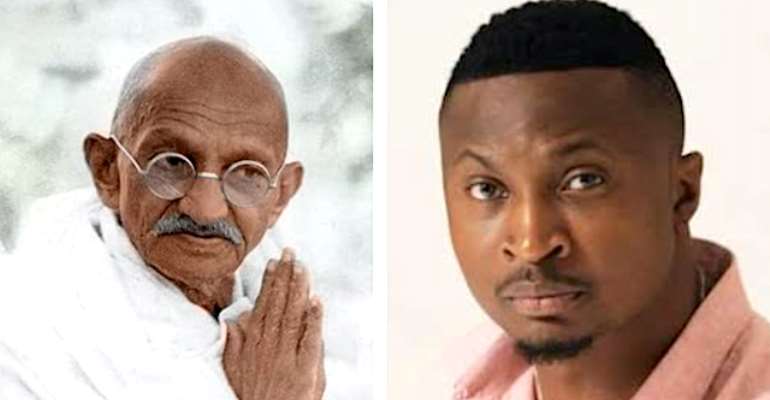
The body of Christ (read: the Church) isn’t immune to toxicity, no pun intended. The contemptuous taunt, “Yet you call yourself a pastor/born again,” is the world’s default way of expressing the same conviction as the venerated Indian revolutionary, Mahatma Gandhi. Circa 1942, the political ethicist declared: “I like your Christ; I do not like your Christians. Your Christians are so unlike your Christ.”
Ages later, Stanley Chibunna, a Nigerian comedian, popularly called “Funnybone”, stirred social media with a thought that is almost a parallel. He posted the following words on his Instagram handle a few days back: “I hope that one day the church understands that being ‘born again’ doesn’t erase childhood trauma or behavioral dysfunction… Some of the meanest people I’ve met call themselves ‘born-again Christians’ because trauma often thrives in the subconscious.”
The passionate pushback elicited by the post shouldn’t come as a surprise. As is to be expected, 2 Corinthians 5:17 became the currency of the conversation. The verse says “If any man be in Christ, he is a new creature: old things are passed away; behold, all things are become new.” Touché, how pertinent! From engagements with the post, some argued by doctrine, while the other school of thought opted for denial. They should know that admitting the existence of a problem is the gateway to extinguishing the same.
Since exegesis of the issue will be the concentration of this intervention, let’s first address pollyannish commenters who can’t imagine mixed multitudes among the saints. These are the holier-than-thou who are used to sanctimony masking melancholy. Even if this is a mischaracterisation, they cannot entirely be dismissed as simpletons, as their idealism may be predicated on what God promised his people in Zion - that’s the house of God, according to Isaiah 61:3. If the oil of joy has replaced mourning and the spirit of heaviness substituted for the garment of praise, how can it then be that people hunted by a traumatic past are still in the congregation? They would query.
Well, here’s the spoiler: those still under the weight of trauma are not only in the pew but on the pulpit as well. That’s if we are to go by Apostle Joshua Selman’s assertion at the Pentecostal Fellowship of Nigeria (PFN) Conference held on October 23, 2025. He thundered, “There is the need to examine the mental state of pastors. Many pastors have spiritualised trauma from childhood, and we come on the pulpit and turn it into sermons.” If this obtains within the rank of pastors, why would anyone think some congregants aren’t so afflicted?
Fortuitously, Pastor Jerry Eze, days later, somewhat reiterated Funnybone’s point of view when he quipped, “Some of us are good Christians, but we are not good human beings.” With 2 Corinthians 13:1 stipulating that “Every matter must be established by the testimony of two or three witnesses,” it is then safe to say that there are indeed believers still being buffeted by the emotional scars of the past. This doesn’t make them any less saved. It’s just that they may be waiting for Godot to do for them what they’ve been empowered to do for themselves.
How absurd it is to imagine that there are sadists among the saints. Yet, there are! If not in the Church, where else should they actually be? You want them distanced from the influence of the Word so they can constitute a menace to the world? Sound sermons and Bible study go a long way in trashing trauma. While Funnybone is right about the presence of people with dysfunctional characters in the house of God, yours sincerely doesn’t entirely subscribe to his recommended solution, what with the warning in Jeremiah 17:5. Seeing a shrink is good, but looking inwards, where the spirit lives, and for mind renewal, is better.
To adequately address the argument, we must acknowledge that man is a spirit being residing in a body that has a soul. That’s the tripartite component of every human being, with the spirit meant to be in the driver’s seat. Those using 2 Corinthians 5:17 as a crutch for their stance in this discussion fail to see that the verse applies to the inner man, not the flesh. This explains why the one who just got born again doesn’t suddenly change in facial and other physical appearances, albeit “all things have become new”. God relates to the human spirit, not the body or soul – that’s the hermeneutic of John 4:24; thus, “God is a Spirit: and they that worship him must worship him in spirit and in truth”.
Trauma is experienced through the bodily senses, and fractures the soul that bears it. The nonprofit veterans’ organisation, We Honor Veterans, coined the term ‘soul injury,’ which they describe as “An overlooked, unassessed emotional, spiritual, or psycho-social wound that traumatically or insidiously separates one from their sense of self” (We Honor Veterans 2024). Since trauma affects both the body and the soul, it will best be exorcised by relying on the spirit, which it can’t breach. Trauma manifests in the flesh, bringing death to those who live by it according to Romans 8:13. The verse goes on to say that “if by the Spirit you put to death the deeds of the body, you will live”.
God has done His part by recreating your spirit upon the receipt of the gift of salvation; the onus now rests on the born-again Christian to train their soul to follow the spirit with the body brought under control. If this weren’t possible, the writer of Romans 12:1 wouldn’t have beseeched you “therefore, brethren, by the mercies of God, that ye present your bodies a living sacrifice, holy, acceptable unto God, which is your reasonable service.” It’s our spirit that has the responsibility to present or keep the body in tow. We must let the inner man do the heavy lifting he has been empowered to do.
Living after the flesh is letting the senses rule over you. That’s what brings about dysfunctional behaviour that is antithetical to the ways of Christ. As the salt of the earth, saints can’t afford to provoke thoughts like “if this is what being born again is like, I’d rather remain a sinner” in people. To avert such misrepresentation of the Lord Jesus, the believer must discipline and train their body to align with their spirit, which has been infused with the life of God, otherwise known as Zoe. As 1 Corinthians 6:19 puts it, “Do you not know that your body is the temple of the Holy Spirit who is in you, whom you have from God, and you are not your own?”
Believers with a traumatic past know better not to rely on their own efforts to defeat the condition. They’ve got to allow the Holy Ghost inside them to quicken their mortal bodies to override natural impulses and subject their souls to alignment with God’s will and purpose. No traumatic hangover can survive that arrangement. Here’s how it works: Your spirit, mingled with the Holy Spirit and filled with the life of God (1 Corinthians 6:17), takes the lead. Your soul, renewed by the Word of God (Romans 12:2), aligns. Then your body is brought into obedience (1 Corinthians 9:27).
From your spirit, the mind is influenced so that it will no longer remember whatever trauma there was. Let your spirit guide your thoughts and actions lest your senses seize the sensation. In the final analysis, the believer has got to keep the old man at bay so that Mahatma Gandhi won’t be proven right! (Ephesians 4:22).
VIS Ugochukwu is a sage, storyteller and branding specialist who welcomes feedback via [email protected]