
Nasarawa's Lithium Revolution: A Defining Moment For Nigeria's Economic Diversification
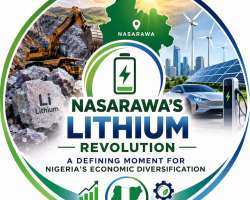
For more than five decades, Nigeria's economy has revolved around crude oil. Oil has financed government budgets, earned foreign exchange, and sustained public expenditure. Yet, despite trillions of naira generated from petroleum, the country continues to struggle with unstable electricity, rising unemployment, weak industrialisation, overdependence on imports, and economic vulnerability whenever global oil prices decline. This paradox raises an important question: can another natural resource help Nigeria achieve the industrial transformation that crude oil could not? The answer may lie beneath the soil of Nasarawa State and several other parts of the country where lithium deposits have been discovered. As the world shifts towards clean energy and advanced technology, lithium has emerged as one of the most strategic minerals of the twenty-first century. Many economists now describe it as the "new oil" because of its indispensable role in powering the technologies of the future.
Lithium is a soft, silvery-white metal that is exceptionally light and highly efficient in storing electrical energy. Unlike crude oil, lithium is not burned to generate power. Instead, it is the principal material used in rechargeable lithium-ion batteries found in mobile phones, laptops, electric vehicles, medical equipment, telecommunications facilities, solar energy storage systems, power banks, drones, military equipment, and numerous industrial applications. Today, virtually every nation pursuing technological advancement is investing heavily in lithium. According to the International Energy Agency (IEA), global demand for lithium increased by almost 30 per cent in 2024, driven primarily by the rapid expansion of electric vehicles, renewable energy storage systems, and digital technologies. Industry analysts estimate that the global lithium market, valued at approximately 43 billion US dollars in 2025, could exceed 180 billion US dollars by 2034. This extraordinary growth explains why countries across Africa, Asia, Europe, and the Americas are racing to secure lithium supplies.
Nigeria is fortunate to possess commercially viable lithium deposits. Apart from Nasarawa State, significant deposits have been identified in Kaduna, Kogi, Ekiti, Oyo, Kwara and several other states. These discoveries place Nigeria among Africa's emerging producers of critical minerals required for the global clean-energy transition. Among these states, Nasarawa has become the symbol of Nigeria's lithium revolution. The commissioning of major lithium processing facilities capable of processing a combined 10,000 metric tonnes of lithium-bearing ore daily represents one of the most significant developments in Nigeria's mining industry in recent years. Although this capacity refers to lithium-bearing ore rather than refined lithium metal, it demonstrates that Nigeria is beginning to move beyond merely extracting minerals towards processing them locally.
This development deserves national attention because the greatest wealth from lithium does not come from mining alone. The real economic value lies in refining the mineral and converting it into high-value industrial products. Countries that simply export raw minerals earn only a fraction of their potential wealth, while nations that refine those minerals and manufacture finished products capture the largest share of economic benefits.
Nigeria must therefore resist the temptation to repeat the mistakes made in the petroleum industry. For decades, the country exported crude oil while importing many refined petroleum products. That model created enormous economic leakages and denied Nigerians the full benefits of their natural resources. Lithium presents an opportunity to chart a different course.
Perhaps the greatest contribution lithium can make to Nigeria is in solving one of the country's most persistent challenges energy insecurity. It is important to understand that lithium does not generate electricity. Rather, it stores electricity efficiently for future use. This distinction is crucial. Nigeria possesses enormous solar energy potential because of its favourable climate and abundant sunshine throughout the year. However, one of the biggest challenges associated with renewable energy is storing electricity when the sun is not shining. Lithium-ion battery technology provides the solution. Electricity generated from solar farms, hydroelectric stations, wind turbines, or even the national grid can be stored in lithium batteries and supplied whenever required. If Nigeria develops a robust lithium battery manufacturing industry, households, schools, hospitals, industries, farms, markets, and government institutions could enjoy more reliable electricity with fewer interruptions. Rural communities currently outside the national grid could also receive stable electricity through solar mini-grids supported by lithium battery storage systems. Such a transformation would significantly reduce dependence on petrol and diesel generators, lower energy costs for businesses, decrease environmental pollution, and improve national productivity. Small businesses would no longer spend a substantial portion of their income purchasing fuel. Manufacturers would experience fewer production disruptions, while hospitals could maintain uninterrupted power for life-saving equipment.
Beyond electricity, lithium offers Nigeria an unprecedented industrial opportunity. Instead of exporting raw ore to foreign countries, Nigeria should establish industries that manufacture lithium-ion batteries for electric vehicles, solar systems, telecommunications infrastructure, medical equipment, laptops, smartphones, inverters, power banks, and other electronic devices. Domestic battery manufacturing would conserve foreign exchange currently spent on imports, create thousands of skilled and unskilled jobs, stimulate research and innovation, strengthen local supply chains, and encourage technology transfer. It would also position Nigeria as a major supplier of battery technology to West Africa and the wider African continent under the African Continental Free Trade Area (AfCFTA). The global automotive industry is already moving rapidly towards electric mobility. Several leading automobile manufacturers have announced long-term plans to phase out petrol-powered vehicles. If Nigeria develops its lithium industry strategically, the country could eventually manufacture battery packs, assemble electric vehicles, and supply neighbouring African countries with affordable clean transportation technologies.
The opportunities do not end there. Local production of lithium batteries could stimulate the growth of industries producing inverters, solar panels, backup power systems, telecommunications equipment, computers, medical devices, agricultural machinery, and defence technologies. In effect, lithium could become the foundation upon which Nigeria builds a modern manufacturing economy rather than remaining merely an exporter of raw minerals. Nevertheless, this enormous opportunity faces a serious threat that could undermine Nigeria's ambition to become a global player in the lithium industry. That threat is illegal mining. Across several mineral-rich states, criminal networks and unlicensed operators continue to exploit Nigeria's solid minerals, often in collaboration with foreign interests. These illegal activities deprive the nation of billions of naira in revenue, destroy the environment, discourage genuine investors, and deny host communities the long-term economic benefits that responsible mining should provide
A recent example is the reported illegal mining activities in Oyo State, where security agencies uncovered operations allegedly involving some foreign nationals working with local collaborators to extract and transport lithium and other strategic minerals outside Nigeria without complying with the country's mining laws. Such incidents should concern every patriotic Nigerian because the nation's wealth is quietly leaving its shores with little or no value added to the economy. While a few individuals may receive short-term financial gains, Nigeria loses far more through lost taxes, employment opportunities, industrial development, technology transfer, and foreign exchange earnings.
This unfortunate situation demonstrates that protecting Nigeria's mineral resources cannot be left to government alone. Traditional rulers, community leaders, youth organisations, civil society groups, and every patriotic citizen must work with security agencies to expose illegal mining activities. Host communities should understand that allowing illegal miners to operate ultimately impoverishes future generations. Minerals that should finance schools, hospitals, roads, industries, and employment opportunities are instead enriching criminal networks and foreign economies.
The Federal Government has recognised both the opportunities and challenges within the solid minerals sector. In recent years, important policy initiatives have been introduced to transform mining into a major contributor to Nigeria's economy. Among these are the commissioning of large-scale lithium processing plants in Nasarawa State, the deployment of Mining Marshals to combat illegal mining, stricter regulation of mining licences, and policies encouraging investors to establish mineral processing industries within Nigeria instead of exporting raw ore. Government officials have also disclosed that foreign investors have committed more than 1.3 billion United States dollars to Nigeria's lithium processing industry. This growing investment reflects increasing international confidence in Nigeria's critical mineral potential. However, attracting investment alone is not enough. The true measure of success will be whether these investments translate into employment, technology transfer, local manufacturing, export growth, and improved living standards for Nigerians.
Nigeria should therefore develop a comprehensive National Lithium Development Strategy that extends beyond mining. Such a strategy should include lithium refining, battery manufacturing, research and development, technical education, environmental protection, infrastructure development, and strong partnerships between universities, research institutes, and private industries. Our universities should begin training specialists in battery technology, mineral processing, renewable energy systems, and advanced manufacturing so that Nigerian professionals can drive this emerging industry. The government should also provide incentives for companies willing to establish battery manufacturing plants, electric vehicle assembly facilities, and renewable energy industries within Nigeria. Tax incentives, access to finance, industrial parks, stable electricity, transport infrastructure, and clear regulatory frameworks will encourage investors to manufacture locally rather than simply export raw materials.
The comparison between crude oil and lithium offers Nigeria an important lesson. Crude oil enriched the nation, yet many of its downstream benefits were realised outside the country because Nigeria exported raw crude while importing many finished petroleum products. Lithium presents an opportunity to reverse that pattern. A tonne of refined lithium chemicals or finished battery products generates significantly greater economic value than a tonne of unprocessed ore. Likewise, a battery manufacturing industry creates far more employment than mineral extraction alone. The future global economy will increasingly be shaped by renewable energy, electric mobility, artificial intelligence, robotics, telecommunications, and digital technology. Virtually all these sectors depend directly or indirectly on lithium-ion batteries. Countries that secure reliable supplies of lithium and develop strong manufacturing capabilities will enjoy strategic economic advantages for decades to come.
Nigeria possesses the natural resources, human capital, entrepreneurial spirit, and geographic advantage to become Africa's leading lithium processing and battery manufacturing hub. What remains is the political will to implement policies that prioritise value addition over raw mineral exports and national development over short-term profit. History has presented Nigeria with another opportunity to rewrite its economic story. The country must not repeat the mistakes of the past by allowing strategic minerals to leave its shores in their raw form while importing expensive finished products. Instead, Nigeria should process, refine, manufacture, innovate, and export products with high technological value.
Nasarawa's lithium revolution is therefore far more than a mining success story. It is a national opportunity to diversify the economy, strengthen energy security, create millions of jobs, stimulate industrialisation, deepen scientific research, expand manufacturing, and position Nigeria as a leader in Africa's clean-energy transition. Together with the emerging lithium deposits in Kaduna, Kogi, Ekiti, Oyo, Kwara, and other mineral-rich states, Nigeria possesses the foundation for a new era of economic prosperity. The challenge before policymakers is not whether Nigeria has the resources, but whether the nation has the foresight, discipline, and determination to manage them wisely. If the right decisions are taken today, future generations may remember crude oil as the resource that introduced Nigeria to the global energy market, but they will remember lithium as the strategic mineral that transformed Nigeria into an industrial, technological, and economically diversified nation. That future is within reach, but it demands courageous leadership, sound policies, responsible mining, and an unwavering commitment to ensuring that Nigeria's mineral wealth first and foremost benefits the Nigerian people.

Dr. Gidado Abdulkarim Salimon writes from No 1b Halal Street Daudu Islamic Village, Ilorin kwara state.
Contact Information: Email: [email protected]