
Beyond Halal: The Case For An Omoluwabi Economy (part 1)
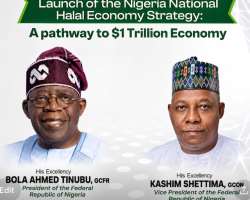
Remarks by Senator Ibrahim Hassan Hadejia, Deputy Chief of Staff to the President (Office of the Vice President), regarding the Federal Government's efforts to develop a "Halal Economy" for Nigeria deserve serious attention.
According to him, the Tinubu administration has spent the past year laying the foundation for a Halal ecosystem that will enable Nigeria to participate in one of the fastest-growing segments of the global economy.
But we ask an important question:
If Nigeria can deliberately position itself within a Halal economic framework, why should other Constituent Nationalities not be free to develop economic paradigms rooted in their own cultural and historical experiences?
For the Yoruba people, the answer lies in what may be called an Omoluwabi Economy.
This is not an argument against participation in the global economy.
Nor is it an argument against Muslims, Islam, or any economic activity associated with Islamic finance and trade.
It is an argument for cultural and economic self-definition.
It is an argument for injecting our Cultural ethos into our political economy thereby providing the shield protecting not only our cultural extinction but also reinforcing its efficacy as part of the global political economy.
Because economic development is not culturally neutral.
For many Yoruba people, the Western Region remains the benchmark of developmental success.
That period was not built on oil wealth.
It was built on education, social investment, regional planning, agricultural productivity, public infrastructure, and a cultural ethic that rewarded learning, diligence, integrity, innovation, and public responsibility.
Those values were encapsulated in the Omoluwabi ethos.
The success of the Western Region did not emerge from an imported religious-economic framework.
It emerged from the creative adaptation of Yoruba cultural values to modern economic realities.
That lesson remains relevant today.
The global economy is not shaped by a single philosophy.
It is a marketplace of competing ideas, cultures, institutions, and developmental models.
The United States reflects its own historical and cultural assumptions.
East Asian economies draw heavily from Confucian traditions emphasizing discipline, education, and collective advancement.
India increasingly integrates indigenous knowledge systems into its developmental strategy.
Israel combines strong cultural identity with technological innovation and global competitiveness.
The Israeli example carries an additional significance for Yorubaland.
At the dawn of the Western Region's developmental transformation, Israel was itself a young state struggling with limited resources and enormous challenges.
Yet cooperation between Israel and the Western Region contributed to agricultural modernization, technical expertise, and developmental thinking that helped shape aspects of the Region's growth.
The lesson being that a people with a clear sense of purpose can adapt global knowledge to local realities without surrendering its identity.
That remains as true today as it was then.
No successful society develops by abandoning its cultural foundations.
Successful societies modernize those foundations.
That is precisely the challenge before Yorubaland.
The debate should therefore not be whether Nigeria participates in the Halal economy.
The debate should be whether all Constituent Nationalities within Nigeria possess equal freedom to develop economic frameworks rooted in their own values and priorities.
An Omoluwabi Economy would begin from a different premise.
Rather than defining development primarily through resource allocation and government patronage, it would place human capital at the center of economic growth.
Education would be the primary investment.
Knowledge would become the principal resource.
Innovation would become the principal export.
Integrity, diligence, honour, responsibility, and the dignity of labour would become measurable economic assets rather than merely moral virtues.
Such a framework would naturally emphasize science, technology, entrepreneurship, manufacturing, logistics, and knowledge industries.
It would seek to produce wealth through productivity rather than dependency.
It would encourage regional integration with Yoruba communities across West Africa and the wider diaspora, including Brazil, Cuba, Trinidad, and other societies with deep Yoruba historical connections.
Most importantly, it would derive its legitimacy from the cultural experience of the people themselves.
This is why the debate ultimately returns to True Federalism.
A genuinely Federal Nigeria should not impose a single economic philosophy upon all its Constituent peoples.
Different regions should be free to develop their own economic priorities within an agreed Federal framework.
That freedom is one of the principal advantages of Federalism.
The Western Region once demonstrated this capacity through its educational revolution, agricultural transformation, industrial initiatives, and international outlook.
Military intervention disrupted that trajectory and replaced regional experimentation with increasing centralization.
The consequences remain visible today.
The issue therefore extends beyond economics.
It is political.
It is cultural.
And it is Constitutional.
A restructured Federal Nigeria would allow Constituent Nationalities to leverage their cultural strengths within a global marketplace while remaining part of a broader Federal union.
That is the context in which the idea of an Omoluwabi Economy should be understood.
The question is not whether Nigeria should participate in a Halal economy.
The question is whether Yorubaland should possess the freedom and institutional capacity to develop an Omoluwabi economy of its own.
Our answer is yes.
Not as an act of isolation.
Not as an act of hostility.
But as an act of self-definition.
That is what Federalism makes possible.
And that is one of the strongest arguments for restructuring Nigeria into a truly Federal State.
The debate must now move beyond Halal.
The challenge before Yorubaland is not whether others should develop economic systems rooted in their cultural values.
The challenge is whether we possess the imagination and political will to do the same.
The Omoluwabi Economy will not emerge from nostalgia.
It must be consciously defined, deliberately cultivated, and institutionally protected.
What are its principles?
How does it create wealth?
How does it compete in a global economy?
How does it differ from the allocation-dependent political economy that dominates Nigeria today?
Those are the questions we shall address in Part II:
What Is an Omoluwabi Economy?