
Hypertension, Diabetes No Longer Sickness For The Elderly As Rising Number Scares Health Professionals
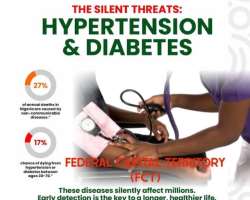
One in three Nigerian adults now lives with hypertension. More than 11 million live with diabetes, and in 2024 alone over 55,000 died from it. The crisis is no longer a disease of the elderly. Doctors in Abuja, Lagos and across the country say young Nigerians in their 20s and 30s are showing up in clinics with blood pressure and blood sugar readings once reserved for their parents, ODIMEGWU ONWUMERE examines. The reasons are familiar but stubborn: cheap junk food, little exercise, sleepless nights, stress, and a healthcare system that charges patients for every test and tablet. The article traces that insulin prices have more than doubled since 2023. Many people stop treatment when money runs out. Others never knew they were sick until a stroke, a heart attack, or an amputation. The article advocates that yet experts say the story is not only about loss. In Abuja, a new Master’s programme is training Africa’s first certified diabetes educators. A foot-care team has cut amputation rates from 50% to 10%. Campaigns by pharmacists and medical societies are taking free checks to markets. The story affirms that what Nigeria lacks, they argue, is not knowledge or good policies on paper, but the political will and money to make them work in every clinic, every community, every day. Without it, the “silent killer” will keep claiming lives in silence.
Abuja-based Dr. Marvelous Idemudia sees it every week at the EFCC Clinic. Young men and women walk in for a routine check and walk out with a diagnosis that used to belong to their fathers. Hypertension. Diabetes. Sometimes both.
“The increasing prevalence of hypertension and diabetes among young adults should not be ignored,” she said during a recent public presentation.
“Unhealthy diets, stress, sedentary lifestyles, and poor health habits are among the major factors driving this trend.”
She is not alone in sounding the alarm. In Lagos, Pharm. Patrick Ajah, Managing Director of May & Baker Nigeria Plc, spent World Hypertension Day watching people line up for free checks. The numbers scared him.
“We have seen cases where people’s blood pressure ranges from 200 over 120, which is almost a killer,” he said.
“Many Nigerians are walking the streets every day without knowing that they have hypertension.”
The Nigerian Hypertension Society puts it in cold figures: one in every three adults in Nigeria has high blood pressure. Fewer than one in five of those patients have it properly controlled.
For diabetes, the picture is worse. Nigeria has an estimated 11 million people living with the condition. In 2024, conservative estimates say more than 55,000 died from it.
That number has climbed steadily from 48,375 in 2021, according to Prof. Olufemi Fasanmade of Lagos University Teaching Hospital.
“The numbers are just the leaves,” he said. “The root causes still need to be addressed: more effort on preventing dysglycemia at every level, through diet, exercise and lifestyle change.”
The roots are not mysterious. Cities are growing fast. Food is changing. Sugar-sweetened drinks are everywhere. People sit more and move less. Sleep is short. Stress is constant. And because most Nigerians pay out of pocket for healthcare, many skip the doctor until something breaks.
Idemudia said many young adults avoid routine checks because they believe blood pressure and sugar problems are for older people. By the time they come in, complications have already started.
“It is important to go for regular blood pressure and blood sugar screenings, get adequate sleep, and manage stress effectively,” she advised.
She tells her patients to eat better, cut down on salt, junk food and sugary drinks, exercise, and rest. For those with a family history, she insists on regular screening because early detection can prevent stroke, heart disease, kidney failure and vision loss.
The cost of waiting is measured in both lives and naira. Since 2023, the price of insulin in Nigeria has risen by more than 200%. Ajah said his company’s factory power bill alone jumped from N65 million a month before 2023 to N170 million now. Those costs end up on pharmacy shelves.
Prof. Felicia Anumah hears the stories daily. She is a Professor of Medicine and Endocrinology at the University of Abuja and Director of its Centre for Diabetes Studies. She also works with the Federal Ministry of Health and consults for WHO. On 11 June she apologised for being two minutes late to a call. She had just come off a live TV segment on hypertension.
“We have beautiful documents,” she said. “But implementation remains a challenge.”
Nine words that sum up 30 years of work. Anumah has helped write most of Nigeria’s policy papers on non-communicable diseases. She knows what should happen. She also knows what does happen in the wards.
“The bomb has already exploded. There is no day we don’t have a stroke in the emergency, from hypertension or diabetes or from both. Heart attacks. Kidney failures. For me, the bomb has already exploded," she said.
She describes patients who vanish from clinics when money finishes, only to return when a foot is infected or vision is failing. Families slide into poverty around a single diagnosis. Doses are skipped. Appointments are missed.
But Anumah has spent her career refusing to only describe the problem. In June 2023, she started something new at the University of Abuja: Africa’s first Master’s degree in Diabetes Education. It is an 18-month programme with virtual classes and clinical training in four teaching hospitals.
The first set of 17 students — doctors, pharmacists, dietitians, nurses, an ophthalmologist, a dermatologist — will write final exams in July. Two civil servants from the Federal Ministry of Health are in the second cohort.
The idea is simple. A doctor seeing 40 patients a day cannot sit and explain to each newly diagnosed person how to live with diabetes without going broke. That job needs a different cadre.
“The medication is one part,” Anumah said. “But empowering the patient to be in charge of this disease is so important.
"We want the patient to be their own doctor, maybe 50%. The healthcare provider does the other 50%.”
Fasanmade says the degree matters because in Nigeria, paper qualifications carry weight. Short courses are ignored. A Master’s can create a recognised profession and push government to fund it.
Anumah has written to the Minister of Health to ask that certified diabetes educators be absorbed into the health system.
Another front in her work is the diabetic foot. She leads the Diabetic Foot Nigeria Initiative and represents Nigeria on D-Foot International. In April 2026 she helped organise a three-day conference in Abuja with experts from India, Egypt, South Africa, Tanzania and Rwanda.
A free session was held for plastic, orthopaedic and vascular surgeons because, she says, “Collaboration between endocrinologists and surgeons is what saves limbs.”
At her centre in the University of Abuja Teaching Hospital, the amputation rate for diabetic foot patients has dropped from 50% to 10%, the lowest recorded in Nigeria. The Endocrine and Metabolism Society of Nigeria has asked other tertiary hospitals to copy the model.
Still, the statistics cannot capture the human cost. Anumah remembers a 34-year-old university graduate, unemployed and unmarried. He had lived with diabetes for 12 years before reaching tertiary care. One leg was already gone.
When he came to her unit the other leg was failing. He had no money. The team did what they could. The orthopaedic surgeons said amputation was the only option. He refused. It was his last limb. One morning his bed was empty. “He died yesterday,” the ward manager said.
“That is the plight of the common Nigerian with diabetes,” Anumah said.
“The resources to care for them are not there. Complications come. And at the end of the day, morbidity and mortality end the story.”
Ajah sees a similar pattern in the markets. During May & Baker’s “Walk for Life 2026” in Lagos, many of those screened were low-income earners and market women.
“Most market women are very hypertensive, but they don’t check. It is getting worse because many people cannot afford hospital bills anymore,” he said. He warned that hypertension and diabetes together are a dangerous mix that speeds up stroke, kidney failure and sudden death.
“Once diagnosed, especially above 40, you are likely going to be on medication for life,” he told participants.
“Many people stop taking their drugs once their blood pressure becomes controlled. That is dangerous.”
The Nigerian Hypertension Society, led by Prof. Simeon Isezuo, agrees. Ahead of World Hypertension Day in May the society said poverty, poor adherence, weak primary care and unhealthy lifestyles are worsening the crisis. Rising costs of drugs, transport and healthy food mean patients ration pills or quit entirely.
Their message for 2026 is direct: check your blood pressure regularly and defeat the silent killer. Members across the country ran free screenings and public enlightenment. They are also running webinars for health workers.
Onwumere writes from Rivers State