
Anti-Tinubu Post: We’re Prosecuting Sowore To Serve As Example For Others, Says DSS DG
The Director-General of the Department of State Services (DSS), Oluwatosin Adeola Ajayi, has called for stricter enforcement and punishment for offenders of the Cybercrimes Act, 2024, who criticize or disagree with government officials or individuals.
Ajayi made the call in Abuja during the public presentation of Electronic Evidence, Second Edition (With Evidence Act, 2011) and A Compendium of Cases on Electronic Evidence (Volume II, 2020–2025), authored by retired High Court judge.
He called for greater collaboration between investigators, prosecutors and the judiciary to ensure effective enforcement of the law and that offenders receive appropriate punishment.
Ajayi disclosed that the DSS is deliberately prosecuting carefully selected cybercrime cases capable of serving as a deterrent.
"What we are pleading for here is support to make sure the rules are enforced and offenders receive the punishment they deserve. If you convict one, that has an impact. Others will be deterred," he said.
He revealed that the Service is prosecuting several suspects for offences under the Cybercrimes Act and explained that investigators deliberately selected a number of high-impact cases to reinforce public confidence in the enforcement of the law.
"We have picked one, or two, or three, four, five, six that will give impact," he said.
Ajayi also disclosed that one of the ongoing prosecutions involves a presidential candidate accused of making online statements against the President. However, he declined to identify the individual because the matter is before the court.
"There is one of them who is a presidential candidate and disparaged a sitting President. We chose that one. I can't talk about him because he is in court," he said.
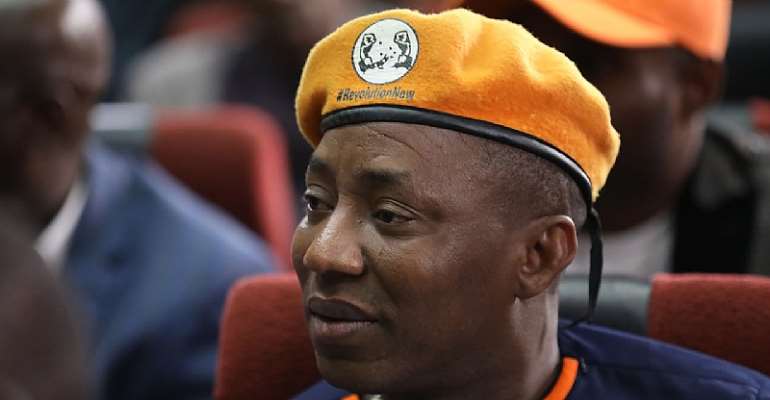
The DSS boss was referring to the active trial of Omoyele Sowore, the African Action Congress (AAC) presidential candidate, whom the secret police are prosecuting over social media posts.
The DSS is prosecuting activist Sowore for alleged cyberstalking and criminal defamation following social media posts labelling President Tinubu a "criminal," with the court ordering a defence after dismissing a no-case submission.
The case, which includes allegations of inciting public disturbance, involves a ₦200 million bail bond and marks an escalation in legal actions against critical online speech.
The DSS Director-General warned that cybercrime extends beyond internet fraud, arguing that unchecked online incitement and irresponsible digital conduct could fuel violence and threaten national security.
"What I know is that if you allow these crimes to go on, you are going to wait for a bigger act. If a man wakes up and says, 'You are this, you are that,' and nobody punishes it, somebody will proceed to carry a weapon and kill one of them," he warned.
He again urged greater collaboration among investigators, prosecutors and the judiciary, saying effective convictions under the Cybercrimes Act would discourage future offenders.
Meanwhile, former President of the Nigerian Bar Association, Wole Olanipekun (SAN), called for a judicial review of the controversial Section 24 of the Cybercrimes Act.
Olanipekun urged judges, academics and legal practitioners to critically examine the Act rather than treat it as beyond scrutiny, arguing that legislation affecting citizens' rights must continually be tested against constitutional principles.
"We are dealing with the Cybercrime Act. We must not leave this place without challenging and interrogating ourselves about that area of our law," he said.
Drawing attention to Section 24 of the Act, which has generated considerable legal controversy over its application to online speech, Olanipekun challenged the Bench and the legal academy to undertake a comprehensive review of the provision.
"I must draw attention now to the Cybercrime Act, Section 24. It's a vital area of our law," he stated.
Addressing the author of the books, he added: "We are giving you that assignment."
According to Olanipekun, the law must strike a careful balance between protecting Nigerians from cyber-enabled offences and safeguarding constitutionally guaranteed freedoms, particularly freedom of expression.
In his remarks, EFCC Chairman Ola Olukoyede linked cybercrime and financial crimes to Nigeria's worsening insecurity and economic challenges, arguing that illicit financial activities sustain terrorism, kidnapping and organised crime.
"There is no doubt that one of the major problems we have in this country is financial crime. Talk of insecurity, talk of lack of economic development, talk of poverty, I think the time has come for us to join hands," he said.
He lamented that many Nigerians only appreciate the devastating consequences of cyber-enabled financial crimes after becoming victims, recounting the case of a judge who allegedly lost about ₦7.2 million, saved over six years, to an online scam.
Beyond cyber fraud, Olukoyede revealed that the anti-graft agency had recently prosecuted about 70 people accused of facilitating terrorism financing.
"Recently, we had to prosecute close to about 70 people who were involved in helping terrorists and bandits launder ransom. This is the foundation of the problems," he disclosed.
The EFCC Chairman also announced that the Commission has begun deploying artificial intelligence (AI) in criminal investigations but warned that Nigeria's legal framework has yet to adequately address AI-generated evidence.
"We have already started deploying AI for investigations. What I'm cracking my brain about is how to generate evidence and make it admissible," he said.
He urged lawmakers and legal scholars to develop legislation governing the use of artificial intelligence in criminal investigations and court proceedings.