
New Chapter, Same Stalemate: Somalia’s War with Al-Shabaab
The Somali government’s battle with Al-Shabaab militants grinds on, with neither able to gain a decisive advantage. To improve its lot, Mogadishu needs to bolster its military and alleviate civilian suffering in areas under insurgent control, while looking for openings for dialogue with the group .
What’s new? The Somali jihadist group Al-Shabaab made major advances in 2025, erasing the government’s gains from two years prior. The government has since regrouped to secure territory around Mogadishu. But swathes of central Somalia remain in the militants’ grip, leaving a stalemate in which neither side can keep the upper hand.
Why does it matter? Al-Shabaab has updated its playbook, including efforts to improve relations with the population in the areas it controls, mitigating its reliance on coercion. These changes have helped entrench its writ. The government, meanwhile, is beset by mounting political infighting as foreign assistance dwindles.
What should be done? Mogadishu should overhaul its military training program and involve federal member states more in plans for countering Al-Shabaab. It should also pursue measures to ease civilian hardship, like encouraging humanitarian organisations to deliver more aid in Al-Shabaab-held territory. A political solution still offers the best path out of the insurgency.
I. Overview
The Somali government’s war with Al-Shabaab, an al-Qaeda affiliate, is at an impasse. In 2022-2023, the government captured large parts of central Somalia from the Islamist insurgents, but Al-Shabaab took back most of this territory in 2025. The group’s advance has since stalled, as the government, with external backing, has pushed back in several areas, particularly around Mogadishu. Such fluctuations of fortune have been typical during this long-running war, which has ebbed and flowed with little prospect of battlefield resolution. To improve its lot, the government needs to bolster its military capabilities, especially as the African Union (AU) prepares to wind down its latest support mission. It can do so by improving training and retention of recruits, while at the same time investing in state-level forces that can help it hold on to lands it has won back from Al-Shabaab. In parallel, it should explore non-military approaches, such as encouraging humanitarian assistance in Al-Shabaab-controlled areas, while also continuing to look for opportunities to convene political dialogue with the group.
In August 2022, the government took advantage of an uprising by the Hawadle clan in the Hiraan region to launch a counteroffensive against Al-Shabaab in central Somalia. By deploying its own troops alongside the clan militias (known as macawisley), it swiftly pushed the militants out of swathes of Hiraan and neighbouring Middle Shabelle. But Mogadishu lacked a long-term strategy for consolidating these advances: it struggled to retain sufficient forces to hold the ground and to figure out a clear role for clan militias. Many of its recruits left the army after being trained. It also suffered from a lack of consistent political support, particularly from federal member states, which never got fully behind the campaign. By 2024, in any case, the government had shifted its gaze to politics, particularly plans for new elections. It was also preoccupied with foreign policy crises, including Ethiopia’s January 2024 agreement to recognise Somaliland in return for seaport access, which Mogadishu saw as an attack on its territorial integrity.
With Mogadishu’s attention drifting, Al-Shabaab regrouped to launch a fresh offensive.
With Mogadishu’s attention drifting, Al-Shabaab regrouped to launch a fresh offensive in February 2025. It replaced a number of leaders, reached non-aggression pacts with some of the macawisley militias it had fought in 2022-2023 and signalled to residents of central Somalia that they would face no retribution when it took over their areas once more. The tactical adjustments largely worked, and Al-Shabaab regained control of most of Middle Shabelle and Hiraan in the first half of 2025. A parallel offensive in Lower Shabelle, closer to Mogadishu, was less successful. A combination of Somali and AU forces, with air support from U.S. and other assistance from Türkiye, drove the group out of a string of towns along the Shabelle river it had occupied some months earlier.
Al-Shabaab’s advances in 2025 redrew the map of territorial control to look roughly the same as it had in 2022, prior to the government’s counteroffensive. These losses fuelled concerns among Mogadishu’s foreign partners about the government’s ability to hold off the militants, despite the decades-long project to build-up the Somali state. Declining international funding for the AU mission, which continues to be the backbone of the country’s security architecture, is emblematic of their growing disillusionment. While Mogadishu retains enough local capacity and external support to hold the line against Al-Shabaab, its ability to break the stalemate appears less certain.
If Somalia can get through what is shaping up to be another hotly contested electoral cycle in 2026, the new administration will have a chance to refocus on tackling Al-Shabaab. To that end, the post-election government should put greater emphasis on strengthening the military, including by improving its training programs, and ensuring that it can equip and pay new recruits. Mogadishu should also deepen its efforts to bring federal member states on board with plans to counter Al-Shabaab, healing the fissures that are preventing cooperation. But the battlefield stalemate is just today’s problem. Only a political solution can put an end to this war for good. The Somali government should lay the groundwork now for eventual talks with Al-Shabaab, while also alleviating civilian hardship by encouraging humanitarian organisations to deliver more aid in Al-Shabaab-held territory.
II. Mogadishu’s Fragile Gains
In August 2022, just months after assuming office for the second time, President Hassan Sheikh Mohamud declared “all-out war” on Al-Shabaab. 1 The returning president put taking on the insurgents at the top of his government’s agenda, expanding efforts to undermine the group’s financial networks, as well as countering its ideological outreach to the Somali public. 2 These measures took place alongside a longstanding campaign by the Somali army, backed by the AU’s peace operation and a number of regional and international powers. 3
For several years, the government’s military approach had settled into a pattern of protecting cities under its control, rather than going after Al-Shabaab in the movement’s rural strongholds. In mid-2022, however, an uprising by the Hawadle clan against Al-Shabaab in the central region of Hiraan inspired the government to take a different tack. 4 Seeing an opportunity, Mogadishu started to support the clan militias referred to as macawisley. 5 This strategy quickly bore fruit in central Somalia, and by early 2023 Al-Shabaab had left most of Hiraan and Middle Shabelle regions in Hirshabelle state, along with sizeable parts of Galgaduud and Mudug regions in neighbouring Galmudug state. The group retained a pocket of territory in Galmudug, to which some of its fighters moved, while its bastions in southern Somalia, especially in the Middle Juba region, remained secure as the army largely did not venture there. But the government’s progress was otherwise rapid, and its confidence grew apace. A number of officials boasted that Al-Shabaab would lose all its Somali territory by the middle of 2024. 6
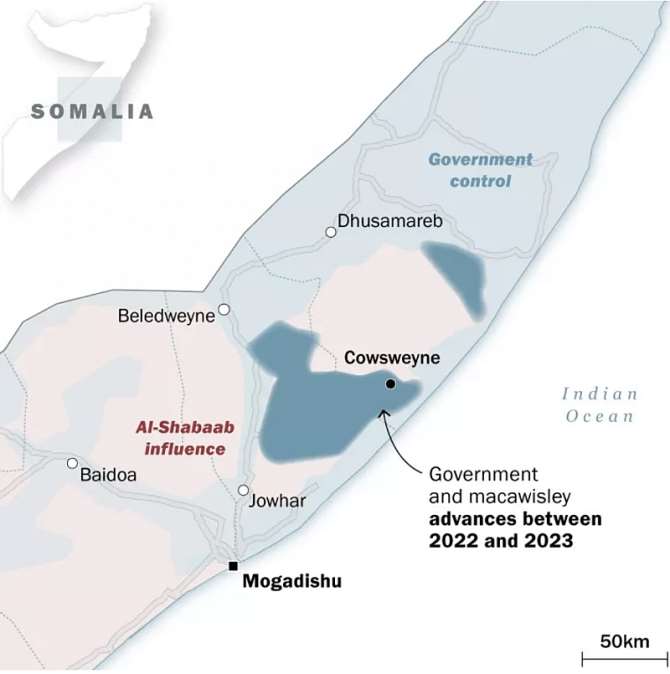
Government gains against Al-Shabaab in 2022-2023. Areas of control are approximate and changes depicted for illustrative purposes only. Front lines in Somalia shift frequently and are contested.Source: Natural Earth, June 2026. CRISIS GROUP
The government’s gains rested on shaky foundations, however, and its counteroffensive began to run out of steam by mid-2023. At first, the decision to support the Hawadle militias appeared wise, but the farther the campaign moved from Hiraan, the more difficult it became to sustain the macawisley model. 7 The catalyst in Hiraan was pre-existing Hawadle antipathy for Al-Shabaab. Elsewhere, the government had to work harder to rally clans to fight the insurgents Macawisley mobilisation also quickly became associated with corruption and fraud. Opportunistic politicians and businesspeople convinced the government to pay them to recruit militias among their clansfolk, but they often delivered only a fraction of the forces they had promised. 8
The government also had to hold the territory it reclaimed, which overstretched its army. Troops then became vulnerable to surprise Al-Shabaab attacks. 9 A devastating assault on a military encampment in Cowsweyne in the Galgaduud region in August 2023 was a turning point, triggering a retreat from positions along the Middle Shabelle-Galgaduud border. 10 The army’s momentum never recovered. 11 An uneasy status quo set in – the government held on to a band of territory it had recovered in central Somalia, but it was unable to push further into Al-Shabaab’s domain. 12 Mogadishu made several attempts to reboot the counteroffensive throughout 2023 and 2024 with little success. 13 As its campaign waned, the government also became disillusioned with the macawisley model it had previously championed. 14
Part of the challenge was that the government was in the midst of developing its armed forces at the same time as it launched an unplanned war. From 2022 to 2023, the government expanded the army by more than 20,000 troops, most of them men. 15 The government sent most of the new recruits to Uganda, Ethiopia, Egypt and Eritrea for up to six months of training, a period widely seen as insufficient for the task at hand. 16 Many were then immediately sent to the front. 17 Some were given inadequate equipment, as Somali officials say partners had promised arms shipments they did not deliver. 18 As a result, desertion became a major problem, with Somali military officials estimating that fewer than half of those trained in 2022-2023 remain in service. 19 Corruption also blighted army development, with food, fuel and ammunition siphoned off before reaching the intended recipients. 20 Fraud is also rife, with “ghost soldiers” – troops who are drawing salaries but are not active – continually appearing on the payroll. 21
The government lacked forces that could take over from the army after its successes.
Another problem was that the government lacked forces that could take over from the army after its successes. State-level Darwish paramilitaries and police filled some of the gaps, but in Hirshabelle and Galmudug too few were recruited to occupy all the areas recovered. 22 The government concentrated on training troops for combat, with little attention to developing forces that could hang onto territory, which would come under state-level command. 23 The result was an over-reliance on the same soldiers involved in the campaign against Al-Shabaab to also hold ground, leading to lengthy deployments and fatigue. 24
Sustaining broad-based political support for the campaign, meanwhile, proved to be an uphill battle for the government. Clan competition hindered cooperation among macawisley units. The government attempted to carry out basic reconciliation between sub-clans, but these efforts did little to overcome deep-seated grievances. 25 Somalia’s political class, particularly the leaders of federal member states, were sceptical of the government’s counteroffensive, especially when it came to engaging the macawisley. These men were concerned that they would be left to deal with emboldened clan militias in their states; others worried that Al-Shabaab’s removal would be a prelude to political changes resulting in their dismissal as well. 26 They went along with Mogadishu, especially when the campaign’s momentum was greatest, but the cooperation was shallow. 27
On top of these challenges, the government failed to develop a comprehensive, long-term strategy. 28 The 2022-2023 campaign originated as a local uprising that the government rushed to support and then extend elsewhere. 29 Yet its approach was haphazard, never settling into coherence. 30 It jumped from one objective to another, often subordinating sustainable military goals to political considerations, including the need to keep demonstrating battlefield success. 31 Oversight of the campaign was too centralised in the president’s office, and decision-making slowed when his attention was diverted by competing priorities. 32 Friction within the security sector, particularly between the defence ministry and army high command, with both seeking to take control of the campaign, further inhibited the effort. 33
Lacking a concrete plan, the government soon became distracted. A showdown with Ethiopia in early 2024 over its proposal to recognise the breakaway region of Somaliland as an independent state occupied much of its bandwidth. 34 Mogadishu then introduced controversial changes to the provisional constitution in early 2024. Critics argued that the reforms undermined Somalia’s federal framework by concentrating power in Mogadishu and initiating sweeping changes to the electoral model that would benefit President Mohamud at the ballot box in 2026. The effect was to further sap national unity in the fight with Al-Shabaab. In late 2024, following a quarrel over regional elections, federal government and Jubaland state forces clashed in Lower Juba, turning their guns on each other rather than the Al-Shabaab militants based nearby. 35 A similar election dispute between the federal government and Southwest state in April 2026 led to a brief conflict. 36
While the campaign against Al-Shabaab was the government’s top priority early in its term, competing political objectives took precedence thereafter. 37 The government proved unable to keep working on weakening Al-Shabaab and reforming Somalia’s domestic political arrangements simultaneously.
III. Al-Shabaab Strikes Back
Following the government’s macawisley counteroffensive, Al-Shabaab spent much of 2023 and 2024 in recovery mode, contemplating how to undermine the government in areas newly under its control. In February 2025, the militants launched a surprise attack in Middle Shabelle, making quick gains and sweeping through the region by April. In July, they repeated the trick in neighbouring Hiraan. They faced stiff resistance at times, but waves of attacks eventually wore down macawisley and army units. 38 A parallel effort in Lower Shabelle launched in March 2025 made gains along the Awdheegle-Afgoye transport corridor that leads toward Mogadishu. This advance, combined with opportunistic forays into Mogadishu’s suburbs by the group, fuelled fears among diplomats that Al-Shabaab might be close to capturing the capital – a stark contrast with the late 2023 comments from government officials predicting the group’s imminent extinction. 39

Lands recaptured by Al-Shabaab from late 2023 through mid-2025. Areas of control are approximate and changes depicted for illustrative purposes only. Front lines in Somalia shift frequently and are contested.Source: Natural Earth, June 2026. CRISIS GROUP
Rather than attempting to enter Mogadishu, Al-Shabaab appeared focused on reversing the government’s gains from its last two major campaigns in 2019-2020 (under President Mohamed Abdullahi Mohamed “Farmajo”) and 2022-2023. 40 As Al-Shabaab advanced, macawisley units grew fatigued, especially as the army struggled to hold positions and supplies from the government dried up. 41 The Hawadle militias in Hiraan held out the longest, but they eventually deserted their posts as Al-Shabaab increased its pressure. 42 The government mounted no significant defence in Middle Shabelle or Hiraan. 43
Al-Shabaab’s military success in 2025 is testament to its capacity to adapt.
Al-Shabaab’s military success in 2025 is testament to its capacity to adapt. After the macawisley uprising and its losses in 2022-2023, the group reshuffled key leaders, giving rise to fresh ideas about how to respond to unprecedented challenges. The group replaced its Middle Shabelle governor early in the uprising in November 2022, bringing back Yusuf Sheikh Isse “Kabakutukade”, who is from the Abgal clan that inhabits much of the state. Leveraging his ties to sub-clans in the area, he worked to persuade some of them not to join the government’s campaign. 44 The group also replaced the commanders of its jabhat (army) and amniyat (intelligence services) in the months before it went back on the offensive. 45 Somali security officials credited the amniyat’s new head, Abdullahi Osman Mohamed (known as Engineer Ismail), with playing a central role in many of the tactical changes behind the group’s battlefield gains. 46
Al-Shabaab made several important adjustments to boost its military strength in 2023-2024. It went on a recruitment drive to bolster its ranks, exploiting commonly held perceptions among the Somali public that Ethiopia had acted aggressively toward Somalia in signing the Somaliland agreement. 47 Al-Shabaab infiltrated parts of the Somali armed forces, gathering information about planned government manoeuvres and conducting insider attacks. 48 The group reinforced its ability to withstand the government’s drone superiority by digging an extensive network of tunnels in central Somalia and regularly seeking refuge in public buildings like mosques or schools, which the government generally chose not to target. 49 Finally, the group developed relationships in a bid to acquire fresh weaponry, including from the Houthi rebels in Yemen. 50
Al-Shabaab also systematically set out to undermine the government’s mobilisation of clans in Hiraan and Middle Shabelle. Deploying members of local clans to engage with their kin, Al-Shabaab signalled to clan militias that had risen up against its rule in 2022-2023 that if they stopped working with the government, it would not attack them or engage in reprisals aimed at civilians. 51 There were a handful of incidents in which Al-Shabaab militants killed civilians, but their return to villages in central Somalia did not bring the mayhem that some had feared. 52 In another example of a shift in approach, the group did not destroy government stabilisation projects in Middle Shabelle upon retaking control, as some had expected. 53
Overall, Al-Shabaab argued that the clans would be well advised to maintain relations with it because they cannot rely on the government. Government forces may briefly take control but will soon withdraw, leaving residents on their own, Al-Shabaab leaders said. 54 At the same time, the group profited from the discontent of certain sub-clans with the Somali government to undermine military cooperation. 55 Somali officials say the group also deliberately stoked conflict between clans to divert the militias’ attention from Al-Shabaab and direct it at their counterparts. 56
After Al-Shabaab’s advance in the first half of 2025, the picture at year’s end was mixed. While the insurgents had swept through inland areas of Middle Shabelle, the government retained control of coastal parts of Galgaduud and Mudug, where Al-Shabaab mounted less of a challenge. 57 The government and its international partners also countered Al-Shabaab’s advance in Lower Shabelle, where any gain would pose a greater threat to Mogadishu. 58 A joint counteroffensive starting in June 2025, combining Somali troops with Ugandan forces both within the AU mission and in a further bilateral deployment, alongside U.S. and Turkish air support, steadily reversed Al-Shabaab’s advance there. 59
IV. A Return to Stalemate
Al-Shabaab’s offensive slowed in the second half of 2025, with the group appearing to prefer retaining the territory it had taken earlier in the year to attempting to make further gains. The government’s decision to concentrate operations closer to Mogadishu, strongly supported by the AU mission, Uganda, the U.S. and Türkiye, also helped halt the insurgents’ progress. 60 As a result, the war has reverted to the stalemate it has been mired in for much of the past two decades. 61
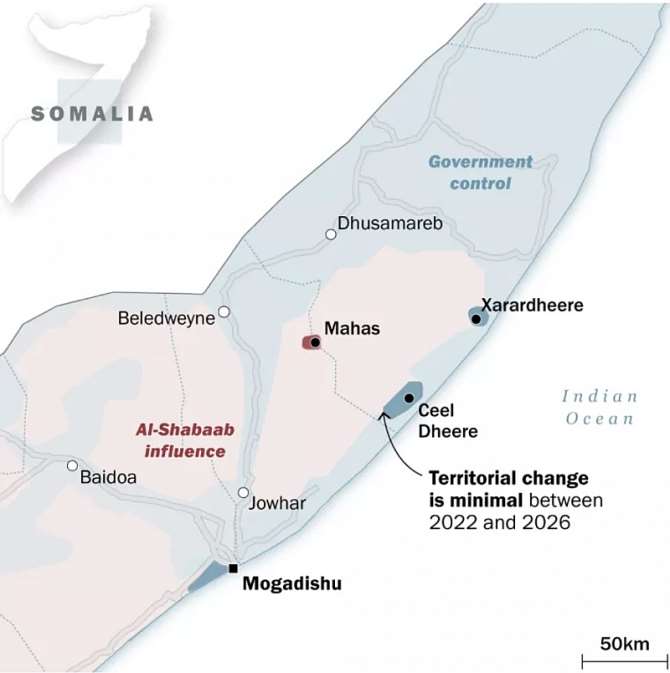
After the government’s counteroffensive and Al-Shabaab’s recovery, the change in territorial control from 2022 to 2026 has been minimal. Areas of control are approximate and changes depicted for illustrative purposes only.Source: Natural Earth, June 2026. CRISIS GROUP
These standoffs are rarely static, however. Frequently, one side gains a temporary advantage, causing a reaction from the other that prevents a decisive shift. In the early 2010s, for example, the government and the AU expelled Al-Shabaab from urban areas in south-central Somalia, including ports it had controlled – which many believed would deal a withering blow to the group’s finances. Yet Al-Shabaab countered by infiltrating cities, generating even more income through extortion payments. 62 In its first years in office, the Mohamud administration sought to reduce this urban shadow presence – with some success – while simultaneously attacking the group’s rural strongholds using the macawisley. 63 Al-Shabaab hit back by undermining the macawisley approach, in part by repairing its poor relations with some of the clans that had risen up against its rule.
The government now appears to have developed a new approach focused on securing areas around Mogadishu where economic development projects are under way, though government officials deny that its military operations are being designed with this end in mind. 64 Drawing on U.S. assistance, it has also stepped up airstrikes and special forces raids on Al-Shabaab leaders, killing a number of them. 65 Al-Shabaab in turn is focused on holding on to the territory won back in 2025, with an emphasis on deterring uprisings against its rule. To this end, it has appointed more local men as administrators and recruited new clan elders to serve as intermediaries with the population. 66 It has also cautiously scaled back practices in these areas that had proven unpopular, including forced recruitment, forced marriage and excessive taxation. 67 The group continues to impose strict rules on dress (particularly for women and girls), as well as bans on tobacco smoking, consumption of khat (a mild stimulant) and smartphone use. 68
Overall, Al-Shabaab seems to be slightly more responsive to public concerns than previously, continuing the approach that enabled it to advance in 2025. 69 In Middle Shabelle, Al-Shabaab has had the most success, in part because some of the Abgal sub-clans appear to be more receptive to its revamped style of rule, whereas it has made less progress toward improving community relations in other areas, notably with Hawadle sub-clans in Hiraan. 70 Outside central Somalia, Al-Shabaab is also displaying greater pragmatism. In Mogadishu, the group has moved away from indiscriminate attacks on businesses like hotels and restaurants, which caused a backlash due to numerous civilian casualties, instead focusing its strikes on government installations to limit collateral damage. 71 In Bay and Bakool regions, the group suddenly lifted a decade-long blockade in early 2025, apparently responding to entreaties from businesspeople, who argued that Al-Shabaab would benefit more from taxing goods than prohibiting trade. 72 The decision also freed up fighters who had enforced the embargo. 73
Al-Shabaab’s approach to humanitarian relief has also continued to change, with the group more frequently allowing aid organisations into areas under its control. 74 During the devastating drought throughout Somalia in 2021-2022, Al-Shabaab had largely blocked humanitarian organisations’ access to areas under its thumb, despite residents’ pleas for help. 75 But in 2023, when parts of Somalia, especially along the Juba river, were hit by extensive flooding, the group sought humanitarian assistance for the affected people. Humanitarian organisations noted that requests from the group declined after the floods eased but began to increase again in 2025, and that discussions of terms of access were elevated to higher levels within the organisation. 76 While Al-Shabaab continues to regulate humanitarian activities strictly, in January 2026, with another drought looming, it announced the formation of a committee to coordinate relief efforts. 77
Al-Shabaab’s adoption of more pragmatic stances, and its cautious re-engagement with communities under its control, is helping re-establish and perhaps entrench the group’s position in central Somalia. The extent to which these changes represent a tactical shift or a more significant transformation in the group’s strategy remains to be seen. 78 Speculation is rife among Somali and foreign observers that Al-Shabaab is undergoing a major political transformation. 79 But that assessment may be premature. The group has yet to make meaningful governance changes, demonstrate the capacity to accommodate people with alternative views or develop a political wing that could engage the Somali government in dialogue. 80
There are good reasons to conclude that neither [the Somali government nor Al-Shabaab] is likely to establish a decisive advantage in the near term.
Al-Shabaab’s new approach in areas under its control, coupled with the government’s focus on establishing a secure arc around Mogadishu, point to continued deadlock between the warring parties. There are good reasons to conclude that neither side is likely to establish a decisive advantage in the near term. Al-Shabaab lacks the firepower to mount a credible challenge to the Somali and international forces in and around Mogadishu. Moreover, despite the signs of a softer approach, its popular support remains low. The government, for its part, has struggled to establish armed forces that can consistently push the insurgents back, while its clan-based militia approach also proved flawed.
Alongside these weaknesses, the government is frequently preoccupied with other priorities, including at present a hotly contested electoral cycle, which stymies the development of a concerted approach, involving the full spectrum of political forces and all levels of state authority in Somalia, to tackling the militants. Mogadishu is also facing the eventual withdrawal of the AU mission, which will hinder its attempts to carry out more offensive operations given its continued dependence on external assistance. 81 By all accounts, its forces have fared better during the campaign in Lower Shabelle in 2025-2026, demonstrating greater capacity to seize ground from the militants. 82 But sustaining operations while taking over all the mission’s nearly 50 bases remains a tall order.
In addition, doubts about the long-term viability of Somalia’s externally funded state-building project are growing. Mogadishu’s international partners, particularly Western countries, have been wrestling with a dilemma for years: they want to reduce their aid to Somalia, but they fear giving the jihadists an opportunity to make more far-reaching gains that might even see them re-establish control of Mogadishu. 83 Non-Western powers, like Türkiye, are widening their footprint, but, despite their well-established commitment to Somalia, they are unlikely to completely replace the security and development assistance provided by traditional partners. 84 The future of international engagement will likely take the form of a more fragmented coalition, involving numerous bilateral partners as well as various interests in play. While Al-Shabaab may be kept at bay, the government may also have difficulty making further military gains.
V. Beyond the Impasse
The cycle of the past several years shows that despite the battlefield swings, the war between the Somali government and Al-Shabaab is fundamentally a stalemate. Getting out of it will not be simple. At various points, each side has surged, but neither has gained a decisive advantage. Al-Shabaab’s main weakness is its relationship with Somalia’s civilian population, which despite signs of improvement remains generally poor, due to its largely punitive, extractive approach to governance. 85 The government, for its part, is overly dependent on outside support that is dwindling, even as non-Western partners like Türkiye step up security assistance. It has yet to develop a security apparatus that can independently beat back Al-Shabaab and consistently hold ground. Nor has it built the wide political consensus that it will likely need to achieve those goals.
Absent significant change, the government and Al-Shabaab are likely to remain locked in a struggle that traps Somalia in a pernicious cycle of conflict for the foreseeable future. Each side has enough firepower to fend off its adversary’s advances but not enough to defeat it. Barring a major inflection point, such as the precipitous withdrawal of AU forces or a sudden economic windfall from Turkish development projects, this general dynamic is likely to persist. 86 To make progress toward ending the war with Al-Shabaab, the Somali government should take measures to strengthen its military capacity, while at the same time fostering greater national political unity and exploring opportunities for dialogue with the militants.
A. Strengthening Somalia’s Military
After more than a decade of external support, the military’s performance has generally been disappointing. Without major improvement, Mogadishu will continue to rely on outside assistance to fight the war. The first step toward better results is for the government to carry out a thorough, impartial investigation of its failure to hold territories gained in 2022-2023. Based on an analysis of its own strengths and weaknesses, Mogadishu should then initiate far-reaching reform of the army and develop a new strategy for taking on Al-Shabaab. This strategy should incorporate key lessons such as the need to recapture territory more methodically to avoid the risk of overstretch. Mogadishu needs to give commanders full operational authority and insulate them, to the extent possible, from political considerations. Any strategy should have the objective of bringing Al-Shabaab to the negotiating table rather than the unrealistic goal of destroying the group.
A new strategy will also need to grapple with the transition that is coming when the AU mission winds down. Central will be ensuring that the government has enough well-trained and well-equipped forces to plug at least some of the gaps the mission will leave behind. Ahead of any big new recruitment drive, the government needs to put in place plans to improve the training of new soldiers, provide them with better equipment and guarantee regular salary payments – all measures that will give them incentives to stay in the army longer. Training should be extended, and it should take place in Somalia, not abroad, so that recruits are taught a common doctrine and set of practices. The army should accelerate efforts to assume responsibility itself, rather than mostly relying on regional partners. Investing in developing a better qualified officer corps should also be a priority, to ensure that troops are adequately commanded.
Money for expanding military capabilities will be tight. The Somali government can appeal to non-traditional donors such as Gulf countries to bridge the gap, but it will have to find ways of bolstering its finances to make any new recruitment sustainable. Options for boosting the budget include cracking down on corruption, imposing more taxation and reserving a large portion of potential profits from the Turkish-led natural resource exploration projects. In any event, the size of the military will have to reflect Somali fiscal capacity. Stretching beyond it will cause problems either through desertion or an influx of trained fighters who lack regular pay.
B. Improving Security Cooperation
Military strategy and training reforms will only go so far. Somalia’s challenges are inherently political, and any increase in federal military capacity can easily be eroded by internal political divisions. The federal government rarely conducts joint operations with the states best equipped to root out militants, namely Puntland and Jubaland. 87 Crisis Group has written extensively about the pervasive political division in Somalia’s federal model, which prevents a unified focus on pressing challenges like Al-Shabaab. Overcoming the prevailing disunity will necessitate a deeper political settlement on issues such as the distribution of power within the federal system. A first step toward such a common vision is to address Somalia’s brewing electoral crisis, where a deal between the government and opposition over the poll’s format and timing is essential. 88
Even without resolving the core problems that have held back the Somali state, the government can do more to help national, state and local authorities stay focused on their common adversary, Al-Shabaab. Mogadishu could, for example, bring member states more into the planning for counter-insurgency operations within their boundaries, setting clear expectations for the different levels of government. 89 It could also spend more on developing state-level forces, such as the police and Darwish. A federal commitment to redirect assistance Mogadishu receives to forces falling under state command could help allay the political deadlock, though realistically such a move is unlikely with regard to Puntland and Jubaland amid the current election-related standoff. 90 In any case, such steps could mitigate member state unease with the notion of a strong national army under Mogadishu’s command being based in their jurisdiction indefinitely. Moreover, they would help address the perennial question about the lack of holding forces, reducing pressure on the army to occupy territory and fight Al-Shabaab at the same time.
C. Nurturing Change in Al-Shabaab
Beyond the battlefield, Somalis who are caught up in the war continue to suffer tremendously. Easing their pain should be a top priority. The war with Al-Shabaab needs to end. Crisis Group has long argued that stopping the war will require negotiations followed by a political settlement between the government and the group. 91 It will take time, however, to reach that stage, as Al-Shabaab will first need to alter its approach in ways that go far beyond what the group has demonstrated to date. In this connection, the government should view the small, pragmatic changes Al-Shabaab has made in relation to governance as an opportunity rather than a threat. It could try to foster rather than stop these adaptations.
One opportunity lies in the gradually widening space for humanitarian organisations to work in territory under Al-Shabaab’s control. The government should actively encourage this shift and limit actions that could have a chilling effect, such as penalising these organisations. 92 Working through intermediaries, for example businesses and clan leaders, and leveraging the public’s demands for outside support, humanitarian organisations can scale up assistance to those living in Al-Shabaab’s domain. 93 This approach should be undertaken gingerly and, if it is successful, the government could signal willingness to allow it to become more widespread, even nudging aid groups to offer more development-style support. Such measures could be a non-political means of engaging communities across the war’s divide, slowly building trust while also promoting more pragmatic change within Al-Shabaab itself. This approach would not be without risk, however. Organisations must ensure that Al-Shabaab is fully aware of what they are doing and abide by the group’s regulations in order to avoid violent retribution. 94
These measures will hardly lead on their own to political negotiations, let alone an eventual settlement, but they can serve as part of a strategic shift by the government toward pushing for an endgame. They can help increase the Somali government’s capacity to hold ground it takes from Al-Shabaab while gradually encouraging political engagement between the government and the group. As Crisis Group has previously argued, a negotiated settlement is the only realistic way to wind down the war. To this end, the government should prepare to embark on a dialogue track with Al-Shabaab combined with military pressure designed to bring the group to the table. While moving from engagement to a negotiated solution is bound to be a long-term endeavour, starting sooner is the best way to avoid prolonging the conflict even more. 95
VI. Conclusion
The Somali government and Al-Shabaab are locked in a battle for survival. The fortunes of both sides have waxed and waned over two decades as each adjusts to the other’s successes without landing a decisive blow. The country’s increasing political fragmentation, combined with a steady drop in foreign assistance, has fuelled fears that Al-Shabaab could overrun the national government in the future. For the time being, however, while Mogadishu faces several big challenges, it retains the military capability, in terms of personnel and resources, to hold the line, provided that external support does not abruptly disappear. Meanwhile, despite Al-Shabaab’s pragmatic shifts in its approach to ruling areas under its control, its unpopularity among those it governs remains a roadblock for its attempts to supplant the government.
With neither side able to defeat the other, the war in Somalia is fundamentally at a stalemate with no end in sight. Advancing beyond this deadlock will not be easy, but the government can learn lessons from the past few years by laying the groundwork for improved military performance and eventual negotiations that could lead to a political deal with the insurgents. While this prospect may be difficult for many to stomach, it is the only realistic way to bring this exhausting war to a close.
Mogadishu/Nairobi/Brussels, 30 June 2026