
Atiku Decries Stringent Bail Conditions As El-Rufai Arrives In Court For ICPC Case
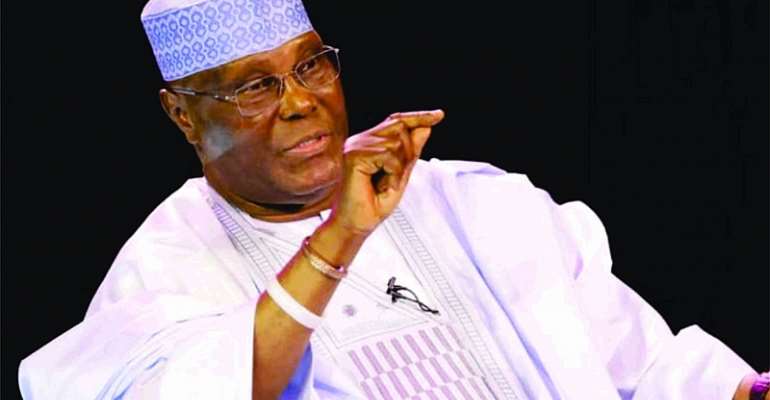
Former Vice President and presidential candidate of the African Democratic Congress, Atiku Abubakar, on Wednesday criticised what he described as excessively stringent bail conditions imposed on former Kaduna state governor, Nasir El-Rufai, warning that such conditions could weaken constitutional protections and diminish public confidence in the judiciary.
Atiku’s reaction came as El-Rufai arrived at the Federal High Court in Kaduna around 9:30 a.m. under security escort for the continuation of his trial over alleged financial misconduct instituted by the Independent Corrupt Practices and Other Related Offences Commission.
In a statement issued by his Senior Special Assistant on Public Communication, Phrank Shaibu, the former vice president expressed concern over the court's refusal to vary El-Rufai's bail conditions, arguing that requirements that are practically impossible to fulfil amount to a "constructive denial of bail."
"The law is settled that an accused person remains innocent until proven guilty. Bail exists to preserve that constitutional protection. It was never designed to become a sophisticated instrument for punishment before conviction," Atiku said.
He questioned the rationale behind bail conditions that allegedly require a defendant to provide a serving Grade Level 17 federal civil servant with verifiable property in Abuja's upscale Maitama or Asokoro districts, alongside other conditions.
"Nigerians are entitled to ask a simple question: is the objective to grant bail or to ensure that bail remains unattainable?" he asked.
According to Atiku, the implications of such judicial decisions go beyond El-Rufai's case and could have far-reaching consequences for ordinary citizens.
"This is not merely about one individual. It is about the principles that underpin a democratic society governed by the rule of law. Today it is El-Rufai. Tomorrow it could be any citizen whose liberty depends not on the law but on whether he can satisfy conditions that few Nigerians can ever meet," he stated.
The former vice president further cautioned against any perception that legal processes are increasingly being used to target opposition figures and critics of government.
"No democracy can thrive where citizens begin to suspect that legal processes are being used not merely to prosecute offences but to punish dissent. The strength of a democracy is measured not by how it treats those in power but by how it treats those who challenge power," he said.
Atiku maintained that he was not commenting on the merits of the charges against El-Rufai but on the need to preserve constitutional safeguards.
"The question of guilt or innocence is entirely for the courts to determine. What concerns every patriot is whether constitutional safeguards are being faithfully upheld. The right to liberty, the presumption of innocence, and the right to fair hearing are not privileges to be dispensed at convenience. They are constitutional guarantees," he said.
He added, "There is a name for a situation where a citizen is told he has been granted bail but is simultaneously subjected to conditions that make his release virtually impossible. It is called a constructive denial of bail."
Atiku urged all institutions involved in the administration of justice to uphold fairness, proportionality and respect for fundamental rights, stressing that the judiciary must remain independent and insulated from political considerations.
Meanwhile, El-Rufai appeared before the court for the continuation of proceedings in the case involving allegations of abuse of office, financial impropriety and fraud allegedly committed during his tenure as governor of Kaduna State.
The matter was earlier adjourned to June 24, 2026, after two co-defendants failed to appear in court.
On April 14, 2026, presiding judge, Justice Rilwan Aikawa, granted El-Rufai bail in the sum of N200 million with conditions that included two sureties—one being a serving or retired civil servant on Grade Level 15 and the other a recognised traditional ruler.
The former governor's legal team subsequently applied for a review of the bail conditions, but the request was rejected by the court.
El-Rufai has denied all allegations levelled against him, while the ICPC insists it possesses evidence to substantiate the charges. The two co-defendants are expected to be present as proceedings on the substantive case continue.