
Nigeria's Youth And The Politics Of Exclusion
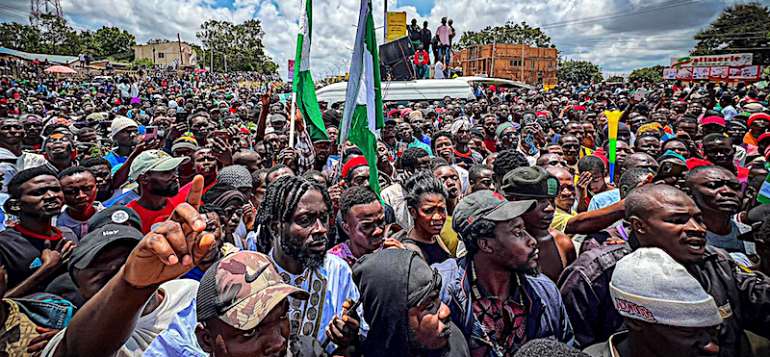
Nigeria boasts a staggering population where over 60% of its citizens are under the age of 30. When effectively mobilized, countries with large youth populations often possess a demographic advantage capable of driving economic growth and political renewal. Nigeria should be one of them. Instead, it is struggling to convert its youth bulge into national progress.
In contemporary Nigerian politics, this immense potential is even more unexplored. The structural architecture of the state has instead, magically created a political ecosystem where the overwhelming majority is systematically governed by an ultra-minority. As noted by the Director General of the National Institute for Legislative and Democratic Studies (NILDS), Professor Abubakar Suleiman, only one percent of elective positions in Nigeria are occupied by Nigerian youth. This is no longer a simple oversight of governance but a profound demographic absurdity.
What makes this statistic so damning is that it persists despite landmark legislative interventions. The passage of the celebrated Not Too Young to Run Act in 2018 was hailed as a historic breakthrough, legally lowering the age qualifications for presidential, gubernatorial and legislative seats. Yet, nearly a decade later, the political arena remains stubbornly resistant to youth leadership. Nigerian youth remain political mercenaries deployed for elite mobilization, rather than emerging as viable political competitors within the electoral arena.
The harsh reality is that future leadership cannot be nurtured in an environment where basic education, healthcare and security for the young are treated as afterthoughts. We cannot claim to be planning for the future while actively starving it.
First, we have reduced democratic participation to a high-stakes marketplace where public office is sold to the highest bidder. This exclusion is laid bare by the astronomical cost of nomination forms, exemplified by the ruling All Progressives Congress (APC) casually retaining its presidential ticket at a staggering ₦100 million for the second consecutive electoral cycle. In a nation where the national minimum wage sits at a modest ₦70,000, these pricing mechanisms are explicitly designed as financial filter systems ensuring competent young minds are effectively priced out.
This financial barrier is heavily reinforced by a chronic neglect of youth development that structurally incapacitates young Nigerians long before they even reach voting age. The empirical consequence of this neglect is reflected in the Global Youth Development Index, where Nigeria ranks 172nd out of 183 countries in youth education, employment and civic participation. By maintaining a system that traps millions of young people in functional underdevelopment, the ruling class ensures that the vast majority are left without the baseline health security, qualitative skills, or economic leverage required to mount any formidable challenge to the status quo.
This continuous recycling of a tired political class acts as a generational bottleneck. When the same handful of political actors are endlessly rotated across decades, structural transformation becomes impossible. Yet, reversing this stagnant trend requires a strategy that goes far beyond mere structural adjustments.
Dismantling formal institutional barriers like the financial cost of entry is only the first step; true rejuvenation demands a deeper approach. It requires intentional leadership development at the earliest stages of youth, paired with a deliberate campaign to reshape the very cultural perceptions that have long conditioned young Nigerians to view themselves as perpetual observers rather than natural inheritors of political power.
Generations of young Nigerians have been fed the patronizing adage designating them as 'the leaders of tomorrow' yet structural barriers ensure that this 'tomorrow' remains a moving target, chronically out of reach.
Ultimately, the indictment for this systemic stagnation does not rest solely on the gatekeepers of the status quo; it falls equally on those who choose the sidelines. True generational shift will not be granted by the benevolence of the ruling elite; it is only guaranteed when the youth decide to play the game.
Abdulhameed Oladele Lukman writes on governance, youth participation, and democratic development. He can be reached via [email protected] .