
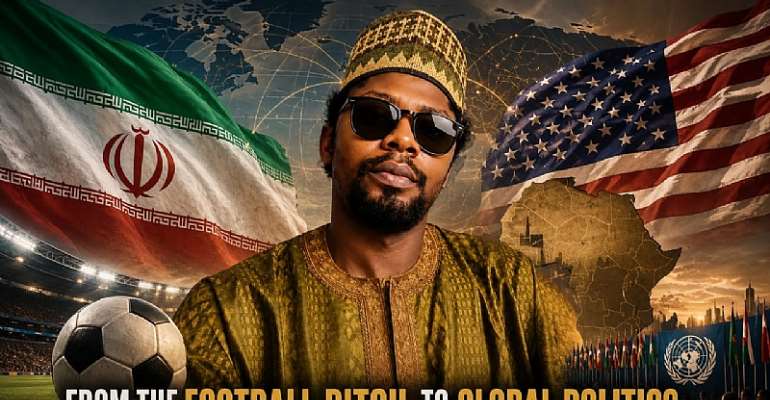
From the Football Pitch to Global Politics: Iran, International Sport, and the Changing Architecture of World Order
Introduction
Sport is often described as one of the few truly universal languages, where political differences fade in favour of fair competition. This idea is appealing, but only partially accurate. International sport has always reflected the same forces that shape global politics: power, recognition, and inequality.
The experience of the Iranian national football team during recent FIFA World Cup qualifying cycles, particularly reported difficulties surrounding travel documentation and visa processing for international fixtures, raises wider questions about access in global sport. While football is formally built on neutrality and equal participation, the movement of teams across borders is in practice shaped by diplomatic relations and levels of political trust between states.
This raises a fundamental question: if sport is neutral, why is participation still so dependent on politics?
The Illusion of Neutrality in International Sport
In principle, international football is governed by rules of neutrality and equal access, most visibly through FIFA’s regulatory framework. On paper, all national teams are treated equally within the competition structure. However, this formal equality conceals a more complex reality.
Athletes and national delegations do not operate in an abstract space. They move through visa systems, embassies, security checks, and state-controlled administrative procedures. These processes are usually presented as technical, yet they become politically significant when relations between countries are strained.
In the Iranian case, reported delays and travel complications illustrate how participation in global sport can be affected without formal bans or exclusions. Disruption does not always appear as overt restriction; it may emerge through uncertainty, timing, and administrative friction. In this sense, sport cannot be separated from politics. Rather, it is one of the clearest arenas in which political tension becomes visible without being officially declared.
Recognition, Mobility and Structural Inequality
At the heart of international relations lies the question of recognition: how states are acknowledged and treated within global systems beyond legal sovereignty. Yet recognition is not only diplomatic; it is also practical. It is reflected in mobility, access, and the everyday functioning of international institutions.
When access to global movement is uneven, whether in diplomacy, trade, or sport, it raises questions about whether international rules are truly universal or selectively applied. For many states in the Global South, participation in global systems can appear conditional rather than equal.
From this perspective, a football match is never just a match. It becomes a symbolic space where inclusion, legitimacy, and hierarchy are quietly negotiated. Participation itself functions as a form of recognition.
A Fragmenting Global Order
These tensions unfold within a global system that is no longer defined by a single dominant power. The post-Cold War moment of unipolarity has gradually given way to a more fragmented and increasingly multipolar order, where influence is distributed across several centres.
States such as China, India, Brazil, Türkiye, Saudi Arabia, and Iran now operate within overlapping networks of economic and strategic relations rather than a single global hierarchy. This shift does not eliminate inequality, but it makes the system more contested and less centralised.
As a result, international institutions face growing pressure regarding how rules are interpreted and applied. The debate is no longer only about enforcement, but also about fairness, access, and representation. Iran’s expanding diplomatic and economic engagement across Asia, Africa, and Latin America reflects this broader transformation, as states seek greater flexibility within a changing global order.
Africa and Strategic Pluralism
Nowhere is this global shift more visible than in Africa. African states are increasingly engaging multiple global partners simultaneously. China plays a major role in infrastructure and financing, Western countries remain central in trade and security, while Gulf and Asian actors are expanding their influence in energy and development cooperation.
This is not inconsistency, but strategic pluralism: the ability to engage multiple powers in order to maximise national and regional advantage. At the same time, the African Union’s efforts to deepen continental coordination reflect a broader attempt to strengthen bargaining power within global systems rather than reject them entirely.
Nevertheless, structural inequalities remain pronounced, particularly in sport, where disparities in funding, infrastructure, logistics, and preparation often shape outcomes as much as talent does.
Sport as Visibility and Constraint
Sport occupies a unique position in global politics because it provides one of the most visible platforms for states outside traditional centres of power. A strong national team can influence international perception in ways that formal diplomacy often cannot. It becomes a source of soft power, visibility, and symbolic recognition.
However, this visibility is uneven. The same system that enables global participation also reproduces inequality through visa regimes, funding gaps, infrastructure disparities, and institutional asymmetries. Sport therefore operates in two directions simultaneously: it connects the world, but it also filters it; it opens doors, but not equally.
Africa’s Agency Within Constraint
Even within these structural limitations, Africa is not merely a passive participant in global sport. It is also an active producer of agency and change. Countries such as Morocco, Senegal, Nigeria, and Cameroon have demonstrated how football can challenge expectations and reshape global narratives.
Morocco’s 2022 FIFA World Cup run, in particular, showed how sporting success can extend beyond the pitch, strengthening national visibility and amplifying Africa’s presence in global football governance debates. These moments complicate dependency-based narratives. They demonstrate that even within unequal systems, states and teams can shift perception, influence discourse, and expand their room for manoeuvre.
Conclusion: Sport as a Mirror of Global Order
The experience of Iran in international football reflects a broader structural reality: global sport cannot be separated from global politics. Movement, access, and participation are shaped by the same forces that structure international relations: power, recognition, and institutional inequality.
In an increasingly fragmented and multipolar world, these dynamics are becoming more visible rather than disappearing. Access is less often guaranteed and more frequently negotiated.
For Africa and the wider Global South, this is not an abstract debate but a lived reality expressed through travel restrictions, funding disparities, infrastructure gaps, and uneven global visibility. Yet within these constraints, agency persists. States and athletes continue to navigate, adapt, and reshape the spaces available to them.
Ultimately, international sport does not stand outside global politics. It reflects it with clarity, revealing a world that is unequal, shifting, and continuously contested.