
Nigeria’s Insecurity And The War Within
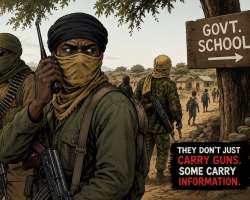
What Nigeria faces today is no longer ordinary banditry in the simple sense many people once understood it. It has gradually taken the shape of a complex internal war where criminals, terrorists, kidnappers, informants, collaborators and compromised systems appear to operate within the same troubled environment.
This is why the fear is spreading. The enemy is not always seen carrying a gun. Sometimes, the enemy may be the person giving direction. Sometimes, it may be the person watching movements in the community. Sometimes, it may be the one leaking information from within a system that was created to protect the people. That is what makes this crisis frightening.
The reported incident in Igboora, Oyo State, where a woman suspected by residents to be an informant was allegedly caught while making suspicious calls, speaks to a larger public anxiety. Whether the full story is eventually confirmed by the police or not, the fear it created is real. Nigerians are beginning to believe that attacks do not happen by chance alone. Many now suspect that criminal groups depend on local guides, informants and people who know the roads, the schools, the weak points and the movements of security agencies. That fear is not without basis.
Nigeria’s Chief of Defence Staff, General Christopher Musa, has publicly complained that bad intelligence from informants has hindered military operations against kidnapping gangs. He explained that informants sometimes mislead troops, sending them to wrong locations while armed groups carry out attacks elsewhere. This confirms that the problem is not only the presence of criminals in the forests, but also the existence of information networks around them.
This is why the language of ordinary banditry may no longer fully capture what Nigeria is facing. In many respects, the country appears to be confronting a form of guerrilla-style insecurity. Guerrilla warfare is not always about open confrontation. It often thrives on surprise, mobility, secrecy, local knowledge, fear, informants and the ability to disappear into familiar terrain after striking.
That pattern is visible in several attacks across the country. Criminal groups strike villages, schools, highways and worship centres. They withdraw into forests or remote settlements. They use local information to evade security forces. They sometimes move victims across difficult terrain. They rely on fear to weaken community resistance and force negotiation.
This does not mean every kidnapper is a formal guerrilla fighter. It means the methods being used increasingly resemble guerrilla tactics: intelligence gathering, ambush, mobility, concealment and psychological pressure.
There is also the terrorism dimension. Boko Haram, ISWAP and other armed groups have long used violence not only to kill, but to frighten society, weaken confidence in government and disrupt education. The abduction of schoolchildren from Chibok in 2014, Dapchi in 2018, Kankara in 2020, Kuriga in 2024 and the recent Oyo school kidnapping in 2026 shows that schools have become symbolic targets.
When children are taken from schools, the goal is not only ransom. It is also fear. It tells parents that classrooms are unsafe. It tells teachers that their work is dangerous. It tells communities that government may not reach them in time. That is psychological warfare.
The economic side is equally disturbing. Kidnapping has become a criminal economy. Ransom payments, food supplies, arms movement, local guides, phone communication, informants and money laundering channels all sustain the system. Every successful abduction strengthens the belief that human beings can be converted into bargaining value.
This is where the role of informants becomes central. Armed groups cannot operate successfully in many communities without some form of local intelligence. Someone tells them who has money. Someone shows them the route. Someone monitors security movement. Someone identifies vulnerable schools, homes and roads.
That is why community vigilance has become necessary. But vigilance must not become jungle justice. Suspected informants should be handed over to lawful authorities for proper investigation. If communities begin to act on suspicion alone, innocent people may suffer, and the real criminals may escape.
The debate around Sheikh Ahmad Gumi also belongs to this wider national conversation. For years, Gumi has argued for dialogue, amnesty and negotiation with bandits. His supporters see him as a mediator trying to reduce violence. His critics see him as someone who has helped normalise armed criminality by giving bandits a public voice and moral explanation.
Whichever side one takes, the concern remains valid: when criminals who kidnap, kill and terrorise citizens are repeatedly described in soft language, society may begin to lose the moral sharpness needed to confront evil. Dialogue may have a place in conflict management, but dialogue without justice can easily become encouragement.
It is also true that reports about Sheikh Gumi’s son joining the Nigerian Army have generated public reactions. However, that fact alone should not be used to accuse the son of wrongdoing. A person should not be condemned because of his father’s public views. The real concern should be institutional trust. Nigerians want to know that recruitment, deployment and intelligence access within the security system are protected from influence, sentiment and compromise.
The same caution should guide discussions around repentant Boko Haram members. Operation Safe Corridor was created to rehabilitate and reintegrate low-risk defectors from Boko Haram. In principle, reintegration can reduce conflict if it is carefully managed. But in practice, many communities remain afraid. Victims ask whether those who once belonged to violent groups can truly be trusted. Others fear that weak monitoring may allow some returnees to reconnect with old networks. Those fears should not be dismissed.
If a former fighter is genuinely repentant, there must still be monitoring, accountability and community-based safeguards. Reintegration must not become a blind process where victims are asked to forget while the state moves on. Mercy without security can become another danger.
This brings us to the Presidency and the national security leadership. President Bola Tinubu has declared security a national emergency and ordered additional recruitment into the police and armed forces. The National Security Adviser, Nuhu Ribadu, has also spoken of gains recorded against terrorists and bandits. These efforts should be acknowledged.
But Nigerians are no longer satisfied with official assurances alone. They want to see safer highways, safer schools, safer farms and safer communities. They want arrests of financiers, informants and collaborators. They want trials and convictions. They want visible consequences for those who profit from blood.
If the President’s hands appear tied, then the people deserve to know what exactly is tying them. Is it politics? Is it weak intelligence? Is it compromise within the system? Is it lack of manpower? Is it fear of powerful interests? Is it the failure of federal policing in a country too large and complex to be secured from Abuja alone? These questions cannot be wished away.
Nigeria cannot defeat this crisis by treating it as ordinary crime. It must be approached as a layered national security emergency involving armed groups, informants, ideology, poverty, forest territories, weak policing, political compromise and public distrust.
The solution must therefore be equally layered. The country needs stronger intelligence, community policing, protection of schools, proper tracking of repentant fighters, prosecution of informants, financial tracing of ransom networks, border control, forest security and punishment for any security personnel found collaborating with criminals. Above all, Nigeria needs moral clarity.
Those who kidnap children are not freedom fighters. Those who guide them are not helpless citizens. Those who finance them are not untouchable men. Those who leak information to them are enemies of the people.
A country cannot continue to bury its citizens while treating their killers as misunderstood guests.
If Nigeria is truly fighting a guerrilla-style war from within, then the first battle is not only in the forests. It is in the information chain, the compromised conscience, the silent collaborator and the weak institutions that allow terror to survive.
Until those hidden hands are exposed, the nation may continue to chase shadows while the real enemy walks among us.
Lawrence Efeturi - Assoc.CIEPUK - The Insight Pen