
Paradise Lost, Paradise Regained: Inside The N23 Billion Bet To Resurrect Obudu

Nigeria's Obudu Mountain Resort, once a neglected gem, is undergoing a N23 billion revival to reclaim its status as a premier tourist and agricultural site. This ambitious project not only aims to restore Obudu's lost glory as a top tourist destination but also seeks to transform it into a key player in Nigeria's agricultural sector, promising significant economic and employment benefits. The resort's decline was a story of political indifference and mismanagement. ODIMEGWU ONWUMERE examines that now, with a comprehensive N23 billion investment, the government and private sector are collaborating to resurrect Obudu, focusing on both tourism and agriculture. The resort is expected to generate over N1.5 billion monthly from accommodations alone, with the potential to create 300 to 500 jobs, revitalizing the local economy and providing new opportunities in hospitality, ecology, and management. Obudu's revival is more than a tourism project; it's a strategic move towards agricultural independence and economic diversification, showcasing the power of public-private partnerships in national development
There is a place in Nigeria where the clouds meet the earth, a place of mist-covered peaks, unique wildlife, and air so clean it feels like a different continent.
It is a place so beautiful that one socio-critic was moved to declare, “If you reside in Nigeria, never go through life without seeing this place at least once... otherwise, your spirit will not forgive you when you die.”
This place is the Obudu Mountain Resort.
Once the glittering crown jewel of Nigerian tourism, a "Camp David" for presidents, and the pride of a nation, it is now a ghost. A N1.5 billion-per-month goldmine that was left to rot, its iconic cable cars frozen in rust, its luxurious suites vandalized, its roofs leaking with the rain of a decade of profound and heartbreaking neglect.
But now, in a story of staggering ambition, a new government is gambling its political will and a war chest of over N23 billion to bring this national treasure back from the dead.
This is the story of Obudu: a paradise lost to political indifference, and the audacious, high-stakes blueprint for its resurrection. It is an analytical look at what went wrong, who is fixing it, and how a plan to revive tourism has awakened a second, forgotten dream of agricultural independence.
To understand the scale of the new N23 billion rescue mission, one must first understand the depth of the rot.
"It breaks my heart each time I am asked to speak on the present state of the ranch," says Lyord Ndoma, a Calabar resident who, like many in Cross River State, speaks of the resort’s golden age with an almost personal sense of loss.
That golden age, driven by the vision of former Governor Donald Duke between 1999 and 2007, is now the stuff of legend. Duke, who once described the resort as the "best piece of real estate in the country," transformed what was a simple cattle ranch into a world-class destination.
"Duke took the resort to the international standard," Ndoma recalls. "Presidents of African countries were coming to do their vacation at the ranch."
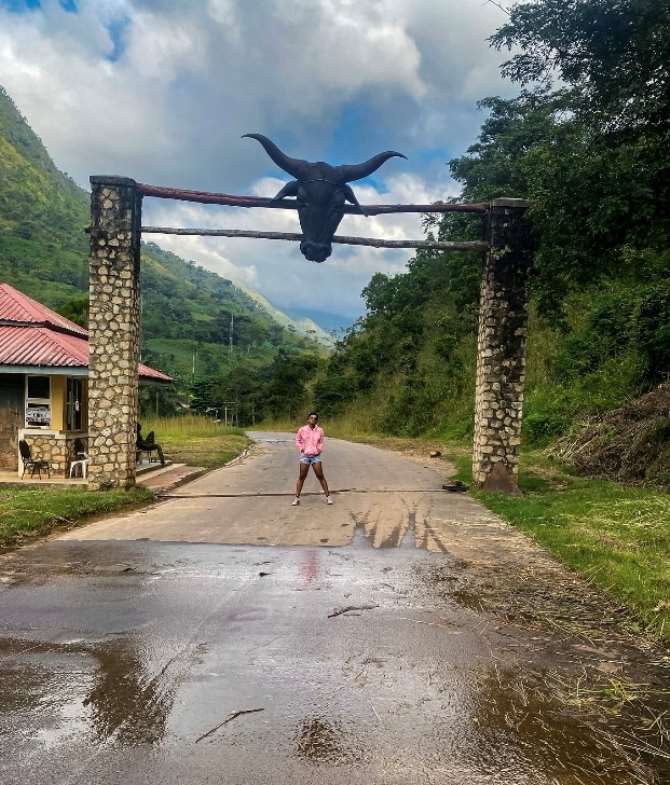
He wasn't exaggerating. Then-President Olusegun Obasanjo held federal council retreats there. His second-successor, President Goodluck Jonathan, did the same. An airstrip was built to manage the sheer volume of traffic from political and corporate titans who flocked to its temperate climate, its international-standard golf course, and its breathtaking cable car—a six-minute, 1,576-meter ascent that was an engineering marvel.
"It was like our own Camp David," Ndoma says. "It became a destination for everybody."
Then, the neglect set in. The decline began slowly after Duke, but it accelerated into a freefall under the administration of Governor Ben Ayade, who was in power from 2015 to 2023.
"I noticed the ranch started depreciating," Ndoma recounts. "The facilities started falling apart. In fact, I wept. It got to a point that the roofs were leaking... When people came in and saw that the facility was falling apart, they were heartbroken. It became an embarrassment."
The cable cars, once the signature attraction, ground to a halt. The structures were left to be vandalized, with reports of even window panes being stolen. A place of stunning natural beauty, home to one of the largest tropical forests in West Africa and unique wildlife, became a forgotten relic.
The previous administration's final act of neglect, according to the new state government, was to lock the dead resort into a 25-year concession agreement with a firm called CIBA Construction Company Limited.
In late 2024, the new administration of Governor Bassey Otu, which had promised to make tourism a cornerstone of its economic policy, took decisive action. It revoked the concession agreement.
In a formal statement, the government detailed its case: the company had "neglected key development obligations," particularly the failure to invest in the renovation of the hotel and other essential components. In short, the firm tasked with saving the resort had, in the government's view, simply watched it die.
The state of Cross River officially took back possession of the resort in March 2025. What they found was a scene of devastation. Preliminary evaluations, according to Sunday Michael, the new Special Adviser to the governor on the resort, estimated the damages and vandalism at N6.8 billion.
For Governor Otu's administration, there was no time to mourn. The N6.8 billion in damages was just the beginning. The governor announced that repositioning the ranch, which he said "did not require rocket science," was a top priority.
The state's first move was to approve an N18 billion fund for several key tourist attractions, with a "chunk" of it, according to Michael, earmarked for Obudu.
The new team, led by Michael, has already begun the painstaking work of resuscitation. "We have begun repairs of the international conference centre, the international restaurant, the spa, the mini golf course, and other amenities," he announced recently.
But the one question on everyone’s mind was the cable car. On this, Michael was clear: "We also want to announce to you, and to the world, that the cable car is being looked into. Within the period of the next three, four months, we'll have the cable car back."
This aggressive state-level push has created a surge of new confidence, unlocking a torrent of federal and private investment that was unthinkable just two years ago.
The Federal Government, in a massive vote of confidence, has confirmed it is injecting N5 billion to "rehabilitate and resuscitate" the resort’s infrastructure. The Minister of Arts, Culture, Tourism, and Creative Economy, Hannatu Musa Musawa, announced the investment as part of a national strategy to build alternative revenue streams beyond oil.
The investment has already "triggered fresh investor interest." A private sector investor, Musawa confirmed, is now building an airport at the resort. And in a move that solves one of the ranch's most crippling logistical problems—its lack of power—the United Nations Industrial Development Organisation (UNIDO) is providing a $2.5 million (2.5-megawatt) electricity solution.
Suddenly, the Obudu resurrection is not just a local project; it is a national mission, a symphony of public-private partnership.
The "why" behind this N23 billion-plus gamble is simple: the economics are undeniable.
Sunday Michael lays out the staggering potential. "The ranch has the capability of generating over N1.5 billion naira in accommodation alone every month," he says. That single, mind-boggling figure—N1.5 billion monthly—would fundamentally rewrite the economy of Cross River State.
The human impact is just as profound. Dr. Erasmus Ekpang, the state Commissioner for Information, explains that the resort, even in its near-abandoned state, has 200 workers (130 of whom were inherited from the previous administration and are now being paid by Otu).
But once the rehabilitation is complete? "It has the capacity to create between 300 to 500 employments, both on a full-time and casual basis," Ekpang confirms.
These are not just jobs; they are careers in hospitality, ecology, and management that will transform the livelihoods of the entire region.
But the new vision for Obudu is even bigger than tourism. It is a brilliant return to the resort's almost-forgotten origins.
Before Donald Duke's cable cars, Obudu was a cattle ranch, first established by a Scottish rancher in 1949 and later developed by the visionary Premier of Eastern Nigeria, Dr. Michael Okpara, in the 1950s and 60s.
Now, the Federal Government sees Obudu not just as a place for eco-tourism, but as a "low-hanging fruit" for its national livestock transformation agenda. The Minister of Livestock Development, Idi Mukhtar Maiha, recently outlined a strategy to use Obudu’s unique temperate climate, rich biodiversity, and secure, vast landmass for large-scale livestock farming and dairy production.
For agricultural experts like Simon Ogbaji, this is a game-changer. "If the ranch is put to use, we will not depend on the North for beef production again," Ogbaji explains. "There will be enough production of milk and beef in Cross River."
The vision is now complete. The Obudu of the future will be a dual-purpose miracle: a world-class eco-tourism hub generating billions in revenue, and a strategic agricultural center providing food security for the entire southern region of Nigeria.
The new revitalization team, which took over in March, has promised a new beginning, a resort "stronger, more vibrant, and ready to welcome visitors from around the world."
The rot was deep, the N6.8 billion in damages a testament to a decade of neglect. But the N23 billion coalition of state, federal, and private capital is a powerful antidote.
Onwumere writes from Rivers State.