
Ogoni Distances Its People From Rivers State Local Government Elections; Framing It As Colonial imposition.
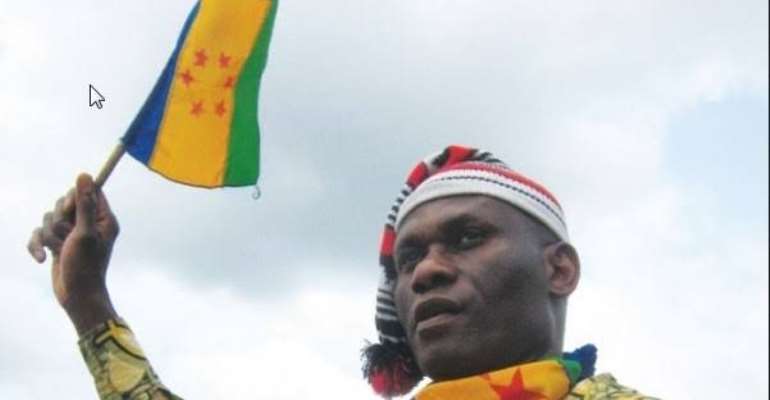
Goodluck Diigbo, speaking on behalf of the Ogoni Central Indigenous Authority, emphasized the need for dialogue and cooperation between the Ogoni people and the government, rather than conflict. He stressed that the Ogoni people do not seek handouts or paternalism, but rather respect and parity in their interactions with the government. "Partnership begins with parity, not prolonged debate without truth," he declared. "When dignity is restored, justice will be real."
Addressing the issue of Ogoni agitation, Chief Diigbo argued that the term "agitation" itself is a misnomer, as it implies that the Ogoni people are somehow responsible for their own plight. Instead, he maintained that the Ogoni struggle is a response to decades of environmental degradation, silence, and marginalization. He pointed out that the government's promises of cleanup and development, including the establishment of a university, are insufficient without meaningful action and genuine consultation.
Chief Diigbo highlighted the need for a jointly reviewed UNEP report, guided by due process, to address the environmental damage inflicted upon Ogoniland. He questioned the government's commitment to genuine cleanup and development, asking rhetorically, "What doctor diagnoses a disease and delays treatment for 14 years? For a land poisoned for over 75 years, would you trust an expired prescription?"
Regarding the controversy surrounding Rivers State's political upheaval, Chief Diigbo expressed concern that the imposition of a Sole Administrator undermines Nigeria's constitutional provisions on local government autonomy. He cited Section 7(1) of the 1999 Nigerian Constitution, which guarantees democratically elected local government councils, and noted that Supreme Court rulings have consistently affirmed the importance of electoral legitimacy.
Chief Diigbo declared that the Ogoni people will not participate in any electoral process that denies their right to self-determination. Instead, they will continue to conduct their own elections through transparent and accountable institutions that reflect the will of the Distinct Ogoni Nation. He invoked the UN Declaration on the Rights of Indigenous Peoples, which affirms the right of indigenous peoples to determine their own political status, govern their internal affairs, and maintain their distinct institutions.
In conclusion, Chief Diigbo reiterated the Ogoni people's commitment to autonomy and self-determination, stating, "Democracy must be earned, not enforced. We reject imposition. We embrace autonomy."
The full text of the press conference by Dr. Goodluck Diigbo (President, Ogoni Central Indigenous Authority (OCIA)
35th Anniversary of Ogoni Bill of Rights (OBR)
[August 26, 1990 = August 26, 2025]
Transcript Opening Statement by Dr. Goodluck Diigbo
Let me begin by saying this clearly: Ogoni resistance reached its climax in 2012 when we declared self-government. That was not a protest—it was a legitimate act of reclamation of our rights and freedom. Since then, we have not been engaged in resistance. Instead of resisting, we have been governing.
What we face today is not Ogoni resistance—it is implicit resistance to Ogoni. The Nigerian state, through absence of consultation, absence of honest and constructive dialogue, absence of sincere respect for our indigenous customs and traditions, is by implication resisting our autonomy, our freedoms, and our right to self-determination.
And that is why UNDRIP Article 6 states unequivocally that: Every indigenous individual has the right to a nationality.
And that is amplified by Article 3 that Indigenous peoples have the right to self-determination. By virtue of that right they freely determine their political status and freely pursue their economic, social and cultural development.
In same vein, Article 4 Indigenous peoples, in exercising their right to self-determination, have the right to autonomy or self-government in matters relating to their internal and local affairs, as well as ways and means for financing their autonomous functions.
And in reaffirmation, Article 5 maintains that Indigenous peoples such as the PEOPLE OF OGONI, have the right to maintain and strengthen their distinct political, legal, economic, social and cultural institutions, while retaining their right to participate fully, if they so choose, in the political, economic, social and cultural life of the State such as the Nigerian State.
We therefore view recent announcement that the Rivers State Sole Administrator seeks to impose local government elections on the Ogoni people as not just a procedural error—it is a direct assault on our indigenous sovereignty. Under the Ogoni Central Indigenous Authority (OCIA) The Ogoni people have fulfilled every democratic requirement: we have elected our leaders, built our institutions, and governed with transparency for over a decade. We are not asking for permission. We are exercising a right—affirmed by even the outdated Nigerian Constitution that is still use, affirmed the Ogoni Bill of Rights, and affirmed by the United Nations Declaration on the Rights of Indigenous Peoples, and by the African and United Nations charters. The Ogoni Self-Government is a blessing for Nigeria. This is not separatist. It is restoration of order. And is irreversible.” Through constructive dialogue and engagement Nigeria stands to benefit from the Ogoni Central Indigenous Authority (OCIA).
Strategic Framing: Why Ogoni Self-Government Is a Blessing for Nigeria
1. Constitutional Renewal
• Affirms Nigeria’s federal promise: The OCIA model breathes life into Section 7 of the Nigerian Constitution, which guarantees local autonomy. It shows that federalism can work—if respected.
• Restores legitimacy: By demonstrating that governance can be community-led, transparent, and lawful, Ogoni self-government offers a template for constitutional order in a time of democratic erosion.
We are not undermining Nigeria—we are reminding it of its own constitutional soul.
2. Democratic Deepening
• Grassroots democracy in action: OCIA’s elections prove that democracy doesn’t need to be imposed from above—it can be cultivated from below.
• Counterbalance to authoritarian drift: In a climate where unelected administrators are normalized, Ogoni’s model is a democratic corrective.
Where democracy falters, Ogoni stands as a living proof that the people can govern themselves.
3. Justice and Inclusion
• Ends marginalization: Ogoni self-government addresses decades of exclusion, giving voice to a people long silenced.
• Protects indigenous rights: It aligns with UNDRIP and global norms, positioning Nigeria as a country willing to honor international commitments.
Ogoni is not asking for special treatment. We are practicing the rights that every Nigerian should enjoy.
4. Development and Stability
• Local control = better outcomes: When communities govern themselves, development becomes responsive, accountable, and sustainable.
• Reduces conflict: Autonomy defuses tensions that arise from imposed governance, creating space for peaceful coexistence.
Political autonomy is not fragmentation—it is stabilization.
5. Symbol of National Maturity
• A test of Nigeria’s democratic maturity: Can the nation accommodate indigenous governance within its federal framework?
• A model for others: Ogoni’s success can inspire other marginalized communities to seek peaceful, lawful paths to inclusion.
If Nigeria embraces Ogoni self-government, it embraces its own survival.
Conclusion
“The Ogoni Self-Government is not a rebellion—it is a restoration. It is not a threat—it is a blessing. In a nation struggling with democratic backsliding, constitutional confusion, and social fragmentation, Ogoni stands as a beacon of what is possible when people are trusted to govern themselves. We are not resisting Nigeria—we are rescuing it. The survival of Nigeria depends not on suppressing indigenous autonomy, but on embracing it. Ogoni is not outside the Nigerian story—we are the MAIN CHAPTER OF THE NIGERIAN STORY RIGHT NOW, A chapter that shows how it can be saved.
DR. Goodluck Diigbo
PRESIDENT, OGONI CENTRAL INDIGENOUS AUTHORITY (OCIA)